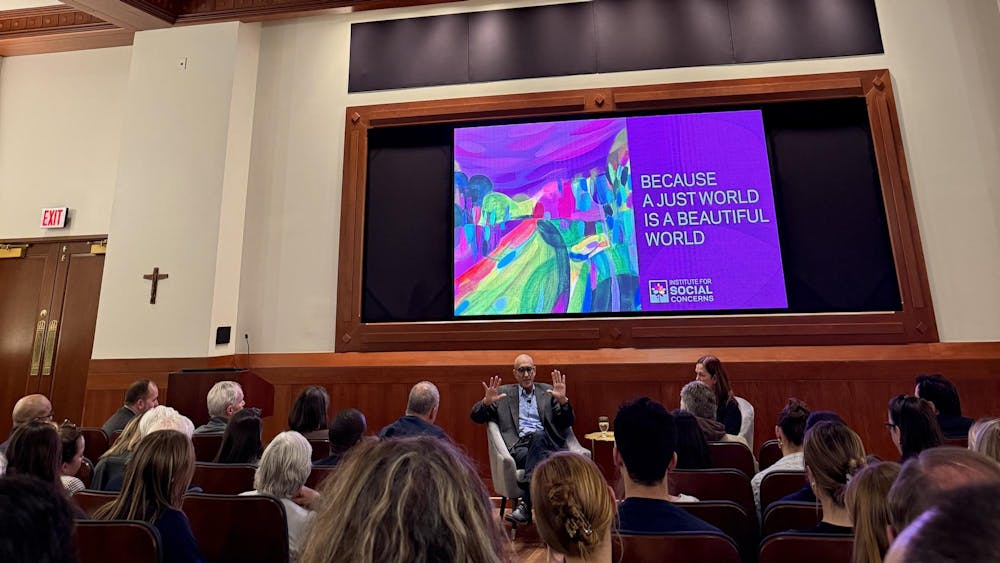
Tom Catena’s resume may stand alone. As a football player, engineer, Navy flight surgeon, doctor and now missionary, Catena’s calling has put him through a wringer of formative experiences. The Catholic missionary and physician spoke at the University of Notre Dame Institute for Social Concerns’ annual lecture in honor of Fr. Bernie Clark this Wednesday. Catena shared an inside look at his past 17 years as the only permanently stationed doctor in Sudan’s Nuba Mountains.
Raised in Amsterdam, New York, Catena first studied mechanical engineering at Brown University before realizing he felt drawn to service work. His original goal was to graduate in four years and join the workforce, but his plans quickly shifted during his time at Brown. After graduating, he attended Duke University School of Medicine on a U.S. Navy scholarship, completed his Navy commitment and eventually left for mission work in Africa.
As a former defensive lineman, he discussed the vital role that football and other team sports can play in physically and emotionally demanding work. “Sports, especially football, are wonderful for anything you want to do in life,” he said. Overnight emergencies, he added, “are like the fourth quarter.” Catena played nose guard for the Bears as an undergraduate at Brown.
His path to Sudan began with a year in Kenya, where he repeatedly met people fleeing conflict in the Nuba Mountains. “People kept coming from Sudan, and they were saying, ‘If you think Kenya is a challenge … they really, really need the help of doctors,’” he said. “I really wanted to go where my limited services were needed.”
In 2007, Catena established the Mother of Mercy Hospital and has been there ever since. The hospital is equipped with 485 beds and treats up to 75,000 patients each year. A typical day begins before sunrise at 5:30 a.m., arriving at the hospital chapel by 6:45 a.m., followed by ward rounds, surgeries and an afternoon clinic. His daily schedule continues after supper with overnight calls via walkie-talkie.
“Groundhog Day, right?” he said. When asked about burnout, Catena reflected on the difference between his work and that of a typical physician in the U.S. While he has experienced the “30 or 40 worst days” of his life in Sudan, he said, “There’s not any one time I have once felt I wanted to be anywhere else in the world.”
Catena attributed the burnout of many U.S. healthcare providers to repetitive tasks and heavy administrative work. A 2020 study indicated that outpatient physicians in the United States spend 44.9% of their time working with electronic health reports.
“In the Nuba Mountains, there is something different every second,” he said. “It’s tiring, but it’s not causing me to burn out, and that’s the difference.”
Catena’s Catholic faith, he said, is essential to sustaining his work in a region affected by war and chronic shortages. The most recent conflict, a civil war between factions of the military, broke out in Sudan in April 2023.
“If I were not a practicing Catholic, I would not still be there,” he said. “There is absolutely no way you can stay in that job … if you’re not a person of faith.”
Reflecting on the difference between happiness and joy, he told the audience that joy comes from meaningful work.
“Happiness is temporal,” he said. “Joy is a feeling that lasts, in knowing what I’m doing is giving me meaning.”
Catena explained the greatest obstacle in the Nuba Mountains is logistics.
“We are the end of the world,” he said. Supplies must be ordered a full year in advance and pass through several conflict zones in South Sudan, through roads that are only open a few months out of the year. “If we forget something in that order, it might be six, seven months before we get it.”
He recounted a recent delivery in which bandits shot through a supply truck’s windshield, killing a soldier riding with the driver. The driver survived, was robbed, and still completed the route. “That’s what we have to go through … to deliver just Tylenol to the hospital,” he said.
Resilience is key in the Nuba Mountains. One frequent patient of Catena’s is Amud, who he says, “has more like 20 lives rather than nine.” Amud survived a bullet wound to the temple and returned months later with a shattered femur. “We put him in traction,” Catena said, and eventually, “he walked out of the hospital back onto the battlefield.”
Students considering medicine, he said, should pursue it for the right reasons. “Pick pursuit of medicine for medicine and medicine only,” he said. “Love science and people.”
He also advised maintaining spiritual practices and growing stronger in faith. “Stay close to your faith, don’t give up on it,” he said. “It will get you through all your difficult times.”
He urged students interested in warzone medicine to gain experience gradually. Not everyone can handle the intense lifestyle. “Soft landing first,” he said. “Don’t come to the Nuba Mountains first — join the army first, then maybe special forces later.”
As the only permanent doctor in the region, the question of who succeeds Catena is up in the air. Catena said his answer is rooted in the mission of teaching at the Mother of Mercy Hospital.
“We started a training school,” he said, noting that physician assistants, midwives and several Nuba doctors are now in advanced training. “We started at zero and are getting to a point where I can slowly step away and let them handle the day-to-day operations.”
Even with the challenges, he emphasized that his work remains rooted in purpose rather than ease. “It’s pure medicine,” he said. “What I am doing is giving me meaning.”