As my final semester of college hurtles towards me, I have — likely more times than necessary — stopped to ask myself: what has defined my four years here?
Have I reached enlightenment through my exposure to ancient literature? Or, perhaps my four years have been characterized by the practical skills I’ve obtained, which will equip me for a corporate career. Have I learned how to be an active citizen or maybe even a better person? From activity to activity on our busy calendars, my peers and I play a delicate balancing act between career preparation and academic exploration, attempting to maintain a semblance of a sleep schedule and social life between the blank spaces.
I’m not the only one trying to define higher education. The purpose of the university in the U.S. has been anything but stagnant. Today, prestigious research universities like Notre Dame have significant roles in society; they act as community stakeholders, revenue-generating entertainment sources and cultivate some of our generation’s best and brightest minds.
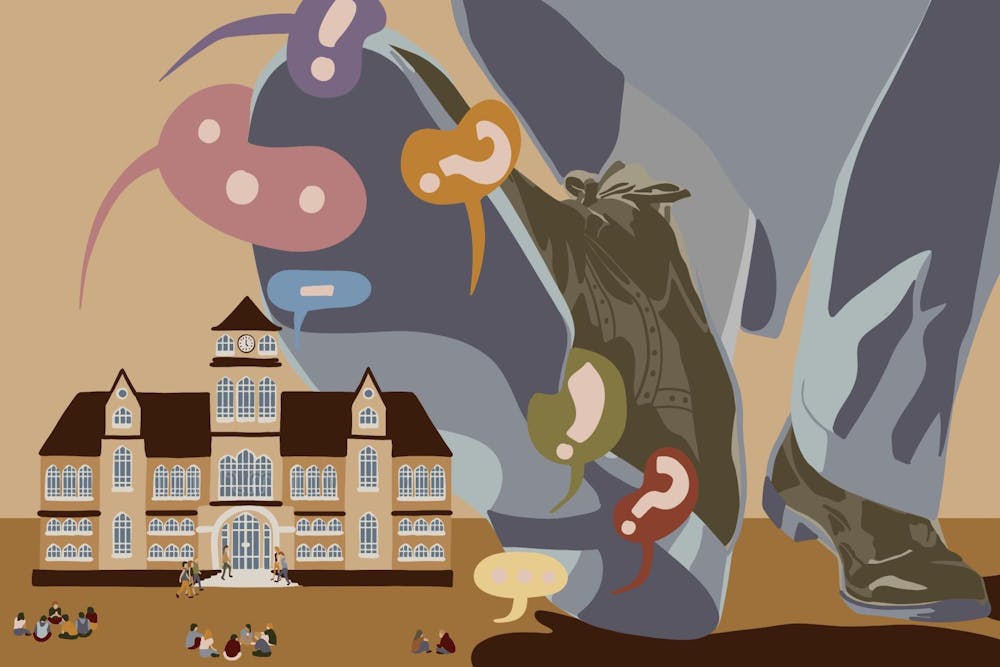
This year, despite their contributions to the nation, higher education has been faced with an unlikely foe: the federal government. President Donald Trump's use of federal funding as leverage for his prerogatives, namely concerns over antisemitism and diversity, equity and inclusion, have resulted in funding threats to over 600 universities and colleges. This past summer, multiple prestigious universities (notably UPenn, Brown and Columbia) regained access to hundreds of millions of federal dollars as a result of their cooperation with the administration’s demands. Other universities, such as Harvard and UCLA, remain entangled in legal battles. Questions remain about the monitoring of such compliance, and if universities who step out of line will be met with an unhappy administration.
A myriad of negative outcomes have materialized from these threats to academic freedom. Last April, my sociology professor showed us the list of words he’d been advised to avoid as they would lead research publications to be flagged. More recently, a tangible decrease in the number of Ph.D. admissions has caused panic. Even universities with comfortable amounts of funding have reduced their incoming class sizes or are considering pausing admissions amid financial uncertainty.
However, pressure on universities does not only stem from the federal government. In March, as news alerts covering frozen funding appeared on my laptop, I was hurriedly finalizing a paper on Thorstein Veblen and “The Higher Learning in America: A Memorandum on the Conduct of Universities by Business Men.” For those unfamiliar with Veblen and his scathing review of the modern university, he vehemently opposes the integration of academia with business schools and other colleges of practical study. Veblen claims business practices have infected the modern university, demanding measurable outcomes from professors and students alike, subsequently tainting the universities’ true purpose: to provoke debate and curiosity. Undoubtedly, Veblen would be horrified at a real estate professional turned politician cutting funding for research, the only kind of work he deemed truly fit for the university.
Paul Blaschko, assistant teaching professor of philosophy at Notre Dame, offers a contemporary perspective of incongruities present on Notre Dame’s campus in his piece “Creating a Culture of Virtuous Leisure in a World of Total Work”. He writes, “I think we all know deep down that the ever-increasing pressures to produce, accomplish, and achieve are somehow incompatible with the environment we’re trying to create as educators”. Perhaps he would find humor in the fact that my Veblen paper was crammed into a three-hour time frame, as I had an interview scheduled for a coveted junior-year summer internship.
This May, eager graduates who may have once embarked on a journey via a federally funded international scholarship may now fall back to plan B — say, a finance position in New York. Is this our nation’s most pressing issue? Certainly not. Yet, I believe it epitomizes an erosion of the pursuit of knowledge, fueled in part by federal overreach and a culture (and economy) that demands our prioritization of a practical path.
As members of a vibrant academic community, we must continually work to ensure the value of learning is not compromised. Our universities should be free to pursue research and focus on cultivating bright minds who can, in turn, pursue their passion — whether in consulting, social work or academia. Those who oppose this ideal should reassess.
Erica Dowd is a senior from Topsfield, Massachusetts, formerly from Pasquerilla West Hall and now living off-campus. She is a Sociology major minoring in Real Estate and Social Entreprenuership & Innovation, and is the Co-Director of Outreach for BridgeND. You can reach out to Erica at edowd4@nd.edu.