Nearly 14 years ago, Notre Dame professors of economics Bill Evans and Jim Sullivan sat down for a conversation with Fr. Larry Snyder, then CEO of Catholic Charities USA, and discovered an opportunity for academics and nonprofits to join forces to find evidence-based solutions for poverty in America.
Notre Dame’s Wilson Sheehan Lab for Economic Opportunity, co-founded by Evans and Sullivan in 2012, partners academic researchers with nonprofits to help evaluate the impact of their poverty alleviation programs. LEO’s team of faculty, graduate and undergraduate researchers generates evidence for what programs are most effective at helping individuals in need. Nonprofits and policymakers can use this data to decide where to direct their resources.
Recalling the conversation with Snyder about how Notre Dame economists could support their mission where the idea for LEO was born, Evans said, “I asked [Snyder], ‘What are the five projects that are run in the Catholic Charities Network that are having the most impact right now?’ And he said, ‘Well, we don't know that.’”
Sullivan added, “That led to a whole series of conversations that made it clear that there was tremendous potential for academics and non-profits to partner to build evidence around what are the most effective ways to improve outcomes for vulnerable populations … The ‘aha’ was the realization that that wasn’t happening.” They wondered how researchers and nonprofits with similar interests could overcome obstacles to partner with each other.
From there, the idea for LEO emerged.
“Poverty is complicated,” Sullivan said. He described LEO’s role as being “a matchmaker to bring academics and providers together to better understand how to fight poverty.”
LEO’s 100-plus projects consist of partnerships around the U.S. in the areas of education, health, housing, criminal justice, economic mobility and other emerging focus areas. For each project, LEO matches academic researchers with service providers to conduct a study to evaluate the impact of their poverty-alleviation programs.
LEO is currently working with Thread, a program that builds mentor networks for low-performing and at-risk students in Baltimore City Public Schools to help increase high school attendance and graduation rates. LEO is evaluating the impact of this program on participants’ high school completion, employment, post-secondary enrollment and criminal involvement.
LEO’s strategic partnerships program director Hannah Darr explained, “One thing that’s unique about LEO is that we primarily do randomized controlled trials, which is like the highest level of evidence.”
In a randomized controlled trial, researchers compare the outcomes of individuals who participated in a program with a control group who did not participate. Because of nonprofits’ limited resources, they cannot serve every person who comes to them. Randomized controlled trials select program participants via a lottery to measure the effectiveness of the program while avoiding the results from being impacted by other factors.
“I think it gives us a lot of credibility when we try to scale it or try to take it to policy makers,” Darr said.
A recent example of LEO’s work is with Padua, a comprehensive case management program in Fort Worth, Texas that matches families in need with case managers who work with them over several years to identify their needs, form goals and connect them with resources to achieve long-term stability.
LEO’s evaluation of Padua found evidence of a 67% increase in the probability that unemployed participants would be working full-time after the intervention and a 64% increase in housing stability amongst those who previously lacked stable housing.
Having evidence for these results helped LEO replicate and scale its evaluation to other programs. Darr shared that this year, LEO secured a gift from a donor to replicate the Padua program in South Bend, the first-ever gift of its kind.
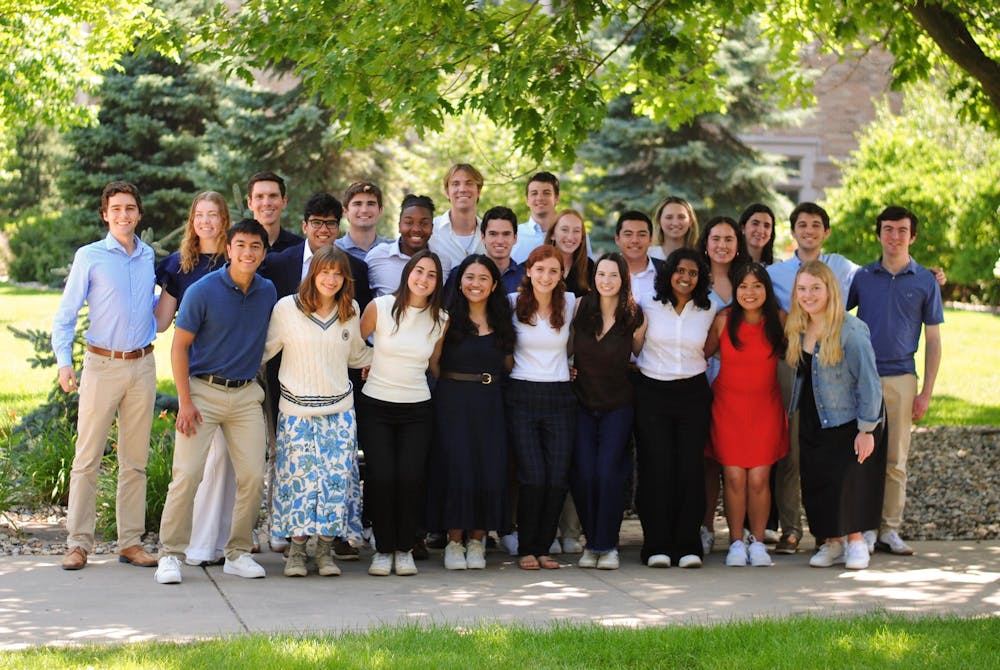
Sullivan noted that undergraduates play a “critically important role” in LEO’s work.
Rohan Jaipuria, a junior majoring in economics from Kolkata, India, started as an intern for LEO the summer following his sophomore year. He spent the summer in South Bend working with one of LEO’s researchers.
“Every intern’s experience is unique,” Rohan said. He applies his economics skills to build data sets using Stata software and explores how projects can ethically integrate AI into their workflow. Other interns put their marketing skills to work for LEO.
When asked about his experience, Rohan said, “I gained a perspective on what exactly I want to do when I graduate and how I should do it,” noting his aspirations to “create something maybe back in India that will help solve poverty.”
Evans recalled choosing LEO’s acronym, saying, “We wanted LEO to be the abbreviation because of Leo XIII's encyclical on Catholic Social Teaching … Now we have Pope Leo XIV, and next year is our fourteenth anniversary, so maybe we can have the Pope on campus.”