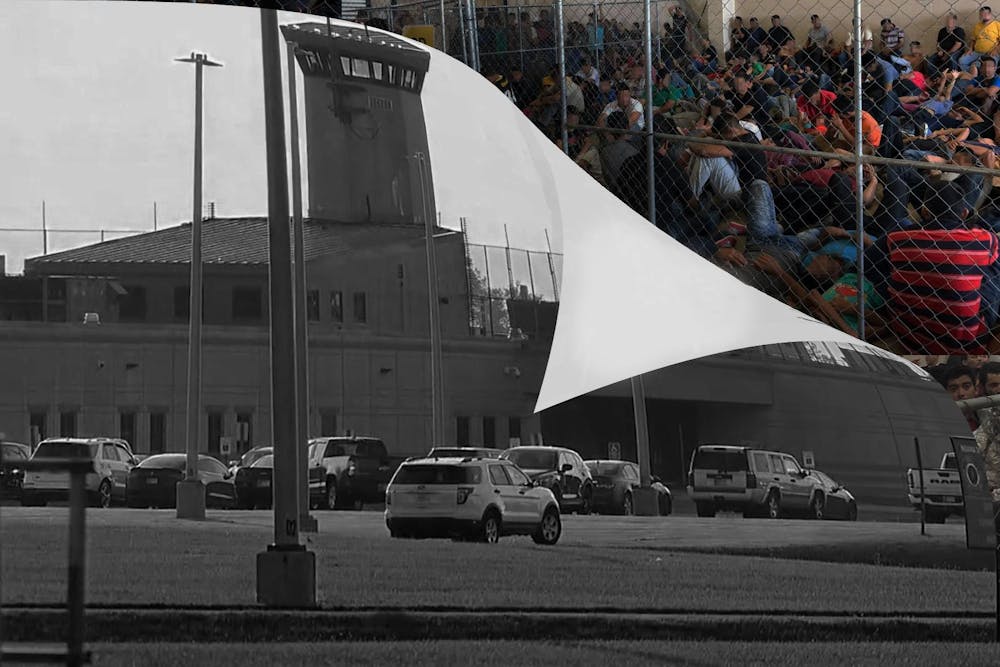
When you wake up in the morning and look out the window, you’re greeted by snow on the trees of South Quad. Maybe you see the dome gleaming in the sunlight, lightly frosted with snow. We take the bright light that shines through our windows every day for granted.
Seventy miles from campus, hundreds of people are detained in gray, windowless cells. Seventy miles from campus, we confront the stark reality of how normalized the dehumanization of immigrants has become in America.
On Aug. 5, ICE and the Department of Homeland Security announced the opening of a new detention center at the Miami Correctional Facility in Indiana. They colloquially named it the “Speedway Slammer.” This name reflects a disturbing attempt at humor that should disgust you. As an Indiana resident for all 18 years of my life, the Indy 500 has been a core part of my childhood. I remember sitting with my twin sister, eating homemade sandwiches as we anxiously waited for the race to start and watching Scott Dixon’s bright red car fly past us. It is abhorrent that law enforcement has taken a cherished piece of Indiana’s history and used it to name a place filled with despair, mistreatment and abuse.
Indiana stands to gain millions of dollars from this deal. The State Budget Committee has already approved nearly $16 million in funding to prepare the Miami Correctional Facility for ICE use. ICE plans to pay Indiana close to $300 per detainee per day — almost seven times the pay rate Indiana pays sheriffs to house state inmates ($42 per day) and nearly four times the current rate of inmates at Miami. If the center remains at full capacity during its two-year contract, Indiana could gain as much as $213 million. In America, illegal immigrants have become an economic commodity.
But how did they end up in this position?
Mainstream narratives often suggest undocumented immigrants arrive by scaling walls or sneaking into ports. The truth is different. In 2017, 70% of undocumented immigrants were visa overstayers — people who entered the country legally at first. Those who attempt to cross the southern border do so out of desperation, often seeking refugee status. However, the refugee quota is set on the president’s discretion. During President Trump’s first term, the refugee ceiling plummeted from 110,000 to 45,000, and reached as low as 18,000 during the pandemic. When people are subject to fluctuating quotas, they take desperate measures, hoping to reach safety and seek asylum once here. That is rarely the reality they face.
America’s immigration detention system is legally classified as civil and “non-punitive” — unlike the criminal legal system most prisons fall under. Yet immigrants are held in prison-like conditions where abuse is well-documented. Those detained under this so-called civil classification can be released entirely at the government’s discretion. The government insists detention is “non-punitive,” yet houses immigrants in prisons indefinitely.
These centers have become breeding grounds for abuse. Between 2010 and 2016, the Department of Homeland Security received 33,126 complaints of sexual and physical abuse in immigration detention centers. More recently, Senator Jon Ossoff of Georgia conducted an investigation into human rights abuses within ICE facilities, receiving 510 credible reports of abuse across 25 states — 41 involving sexual abuse. His report details appalling conditions: 14 pregnant women denied medical care, food and beds, some forced to sleep on the floor due to overcrowding. One detainee testified that DHS staff let a pregnant woman bleed out for days before taking her to a hospital. Ossoff also documented 18 reports of mistreatment involving children as young as two years old, including U.S. citizens. In one case, when a mother begged for medical help as her daughter vomited blood, a guard told her, “Just give the girl a cracker.”
Read Senator Ossoff’s report — it provides damning evidence of the abuse citizens and non-citizens alike face in immigration detention. No human deserves this. No one seeking a better life deserves to be stripped of their dignity. Seventy miles away from our campus, a child may soon be denied medical attention after vomiting blood. Seventy miles away, a pregnant woman may be left to bleed for days before getting help. Seventy miles away, children, mothers and fathers sleep in windowless cells while we take for granted the sunlight that floods our dorms each morning.
It’s easy to feel hopeless when faced with such horror. But the moment we stop caring is the moment we give up. The first step toward change is conversation. Don’t call undocumented immigrants “illegal aliens” or use other dehumanizing terms. Interact with immigrants in your community. Local organizations like La Casa de Amistad and Neighbor to Neighbor offer ways to connect. La Casa de Amistad is always seeking volunteers for its after-school tutoring programs, many serving children learning English. Neighbor to Neighbor provides a friendship-based network to help refugees and immigrants acclimate to life in the U.S.
Finally, call your senators and representatives. Tell them you oppose imprisoning immigrants in conditions of cruelty and neglect. Each small action matters. The more we raise our voices, the harder it becomes for policymakers to ignore them.
Thea Bendaly is a freshman from Carmel, Ind. living in McGlinn Hall. She studies political science and romance languages and is a member of the Glynn Family Honors Program. In her free time, you will find Thea crocheting in her dorm, singing with Halftime A Cappella or hanging around with friends. Please feel free to contact Thea at tbendaly@nd.edu as she looks forward to hearing your thoughts (good or bad) about the column.