Veterans Day, celebrated on Nov. 11, memorializes Armistice Day — the day when World War l ended with a ceasefire in 1918. Each year, the University works to honor veterans’ service and sacrifice with a variety of events.
The Office of Military and Veteran Affairs annually holds Salute to Service Weekend during a home football game weekend. This year, the event was held on Nov. 7 and 8, in conjunction with the Navy game.
The office hosted a pre-game reception for over 400 Notre Dame students, faculty and alumni who are connected to the military. In addition to the reception, admiral Christopher W. Grady ’84 presented a Sojourn 250 flag during the game. According to a University Facebook post, “Several Notre Dame-connected veterans had the honor of holding the flag honoring their service” while on campus.
In addition, the weekend included “live performances of a new song for veterans entitled We All Stand Tall, as well as a live performance of Here Come The Irish,” wrote Sergeant John F. Crowley director of the Office of Military and Veterans Affairs and retired colonel Kenneth Heckel in a statement to The Observer.
“Both were performed by John Scully ‘80 and Cathy Richardson, who wrote and performed the original ‘Here Come the Irish.’ Our event was recognized by the Alumni Association as the ‘Tailgate of the Week,’” Heckel wrote.
Alongside the Salute to Service Weekend, the University hosted a “What is Veterans Law” panel with law professor Caleb Stone, a fireside chat with admiral Bill Houston after he visited the the O’Brien Notre Dame International Security Center and the Keough School and a luncheon and and army breakfast with general Bryan Fenton. Additionally, ROTC students were invited to have lunch with Houston and participated in a 24-hour vigil at the Clarke Memorial Fountain. The Mendoza College of Business also hosted an MBA prospective student veteran visitation day, an opportunity for military candidates to learn about pursuing a business degree.
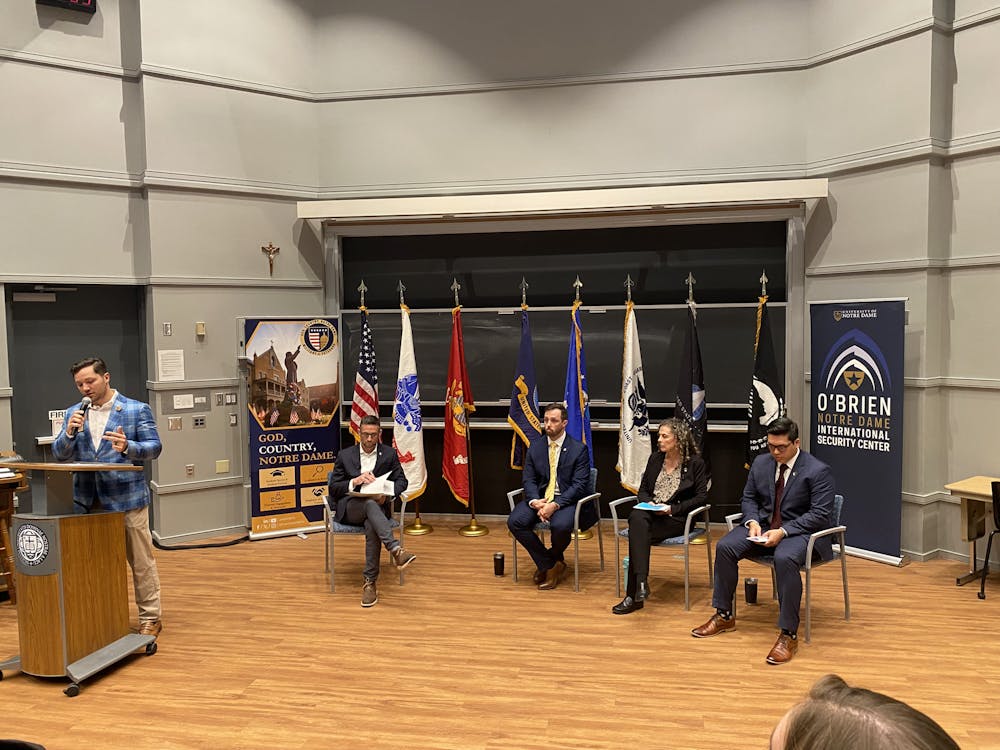
In addition, the OMVA and the O’Brien Notre Dame International Security Center held a panel titled, “Why I served: A Veterans Panel” on Tuesday afternoon.
Technical sergeant and NDLS 1L Tyler Beamish served as one of the panel’s moderators. Beamish came to Notre Dame after serving as a combat controller in the Air Force Special Operations Command. MBA candidate and petty officer first class Rob Parkhurst joined Beamish on the panel, having previously served a decade in the Navy with the Naval Special Warfare Branch.
Commander Beth Webber, representing the Inspired Leadership Initiative and the Shaw Center, was the panel’s final moderator. Webber served aboard the U.S.N.S. Comfort as a member of the Navy Nurse Corps. She now works as a consultant for the Shaw Center, “where she helped develop a 10-week mental health and wellness program to support military spouses and build mental health allies within the military community.”
To begin the panel, each participant reflected on the experiences that led them to service. Beamish’s desire for service began in his youth, initially desiring to become a Navy Seal. His call to service solidified after spending two years at Arizona State University. Beamish also recalled the Boston Marathon bombing as an event that compelled him to serve, noting his desire to “be the person, who when the time comes, [can] act.” Like Beamish, Parkhurst enlisted in the Navy after spending two years in college.
Webber’s ‘why’ began with growing up as a third generation Navy family member, explaining that her family’s service gave her a sense of duty. All three panelists stayed in the military beyond their first term of service, and Webber noted that part of her reason for staying in the military was the lifelong learning it provided.
Each of the panelists was then asked to described a defining moment from their years in service. For Webber, this moment was a trip to New York City following 9/11, when her mission was to provide health care and mental support.
Parkhurst noted that his defining moments stemmed from finding humor in humorless situations.
Beamish echoed Parkhurst’s words, recalling an experience from “hell week,” which he described as “five days of very little sleep, living on your feet with a 60-pound rock on your back.” He continued, “It was 30 degrees out, raining in North Carolina. We had lost half of our class already, and we were in the middle of a rock. And one of my buddies just goes, this sucks. All of us started laughing. All of us were so tired. It was so comical, just so simple.”
Webber also spoke about her unique experience as both a veteran and a military wife, as her husband continued to serve after she retired.
“I would have to say that the job or the role of a military spouse or a military family member is the hardest ... It’s challenging to send them away, to send them away to Afghanistan and not know what’s going to happen.”
To the extent of leaving the military, Webber said, “Eventually you take off your uniform and all your medals and ribbons, but it’s the impact that you left on their soul. I always call it leaving fingerprints on the souls of others.”
The panelists commented on the difficult transition from military to civilian life.
“You’re part of a team and then you’re not on the team, and you miss it,” Webber said.
When asked how to bridge the divide between military and civilian life, Parkhurst asked audience members to remember “Every veteran is just like you.”
He also noted how Notre Dame has eased this transition, saying, “The University has the best veteran network, not just for getting you a job or for helping introduce you to somebody else, but they hold the values of the University.”
In response to positive feedback from veterans like Parkhurst, OMVA is expanding programs that assist veterans, including “exploring ideas to create an undergraduate student veteran fellows program, which will include an array of initiatives and services for our fellows, in collaboration with the University Counseling Center, the McDonald Center for Health & Wellness, the Meruelo Family Center for Career Development, and several other partners,” Heckel wrote.
In addition to the fellows program, Heckel explained that the office is piloting a faith-based retreat in collaboration with Campus Ministry, “where up to 6 of our student veterans will travel to Italy for a pilgrimage that retraces the journey of St. Francis of Assisi.”
The O’Brien Notre Dame International Security Center also offers programs to assist veterans, including a “a three-year PhD. Program for active duty officers from Air Force, Army, and Marines. We’d welcome Navy and Space Force as well … The military and civilian students are both vital parts of our program,” professor Michael Desch wrote in a statement to The Observer.
Desch continued, “Through training the next generations of leaders in national security, we honor soldiers, sailors, etc. by ensuring that civilian leaders understand when and how our military can be used most effectively to ensure our nation’s security. We believe that supporting the troops means asking them to go in harm’s way only when it is in our nation’s vital interest.”
Professor Ian Johnson echoed Desch’s words, writing that these programs are urgent projects “In a society like ours, where civilians ultimately decide the key questions of national security.”