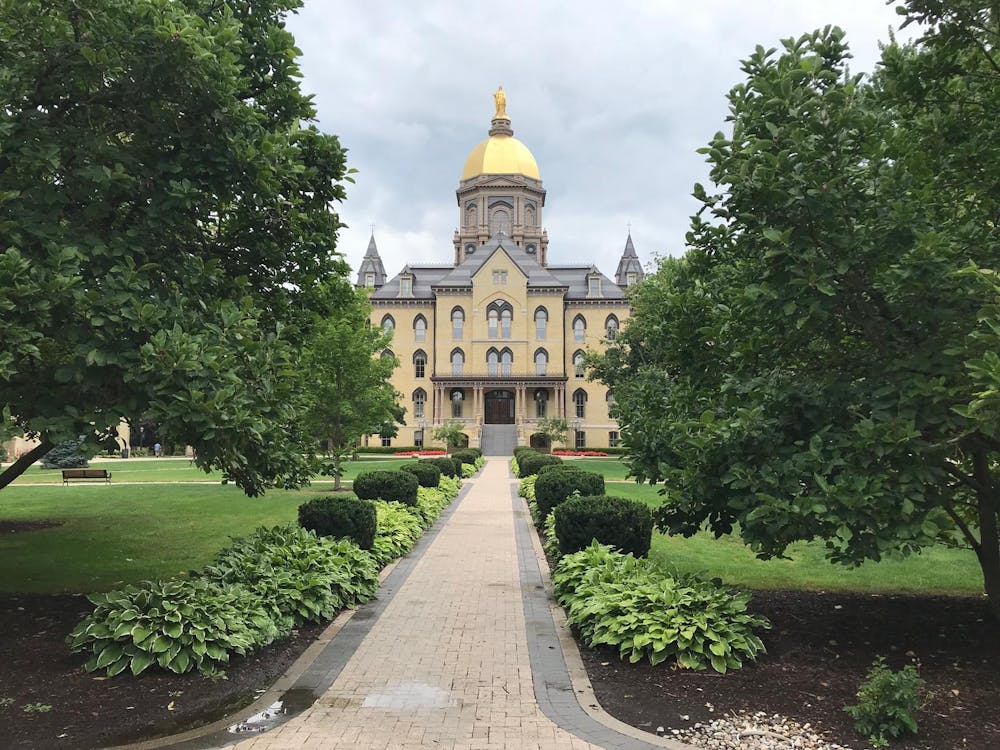
Being a tour guide at the University of Notre Dame is one of the most sought-after campus jobs, with roughly 100 guides on call. Football weekends are full of prospective students and families, many taking advantage of programming from the Office of Undergraduate Admissions.
Roughly 50 tour guides work on a football Friday, running 90 minute tours over a seven-hour period. The office is prepared for the challenge, with a tour coordinator hiring extra guides to fulfill the increased demand.
To become a tour guide, students submit multiple essays related to their Notre Dame experience and participate in an interview. If hired, they attend a two-hour training and give a mock tour. The training cultivates skills like public speaking and memorization. On average, guides give anywhere from one to three tours a week, depending on their availability and the number of tours given.
Each tour begins with an information session where the tour guides introduce themselves. Then, students and families pick their guide based on similar interests or potential majors. The groups leave through McKenna Hall to begin walking predetermined routes around campus.
Guides must prepare for each tour. They keep in touch with campus developments, plan new routes depending on daily events and remind themselves of content through a fact sheet that is dozens of pages long.
Junior Tami Alli familiarizes herself with football Friday programming to accommodate curious families. She describes the Friday tours as “more challenging than a normal weekday” because of the sheer amount of people on campus. She alters the way she gives tours by stopping to talk instead of walking backwards to allow everyone to hear her.
“Notre Dame is someone’s dream school, and I get to show them around and sell them on Notre Dame. It is also a really cool way to meet different people; I have met so many people from all over the country, the world even … It is a good way for me to take a break from my busy week and connect with families,“ she said.
Junior Kieran Lobo reviews the tour guide manual and keeps himself up to date with developments around campus, such as the new disability services minor. He strives to answer any question a prospective student could have.
He also loves “being able to meet a lot of amazing people” and seeing current students around campus who he gave tours to when they were applying to Notre Dame. He values his opportunity to “make an impact on their journey to coming to Notre Dame … that has been the most fulfilling, amazing part of being a tour guide,” Lobo said.
Junior Maya Tuviera appreciates the opportunity to help students and families discern where to go to college.
“I think going to Notre Dame was the best decision I could have made and I want to help other people make that decision too,” she said. “It is very fulfilling to see students who are initially a bit shy or uneasy or maybe not necessarily as open gradually become more enthusiastic about the prospect of coming here.”
Tuviera loves watching students realize that the University “has become a possibility for them.”
Lobo aims to be personable and charismatic for his tour and create a connection between him and the students.
“At the beginning of my tours I ask all my students to tell me their name, where they are from and what major they want to do. Throughout the tour, I try to remember those facts about them,” he said.
Alli also makes her tour as relatable as she can by tailoring what she talks most about around her participants. As a science student, she spends more time in the Jordan Hall of Science answering questions and sharing her experiences. Alli tries to “represent the University to its fullest while being authentic on tours” and loves how the diverse cohort of tour guides represents various groups from the Notre Dame student body.
In an effort to make their tours more unique and memorable, the office began taking photos of prospective students and their families.The tour guides may sign the card and give it to them at the end of the tour.
Tour guides also represent the University, where Lobo describes them as “the first people that you see.”
Students will be able to apply for open tour guide positions in the spring semester.