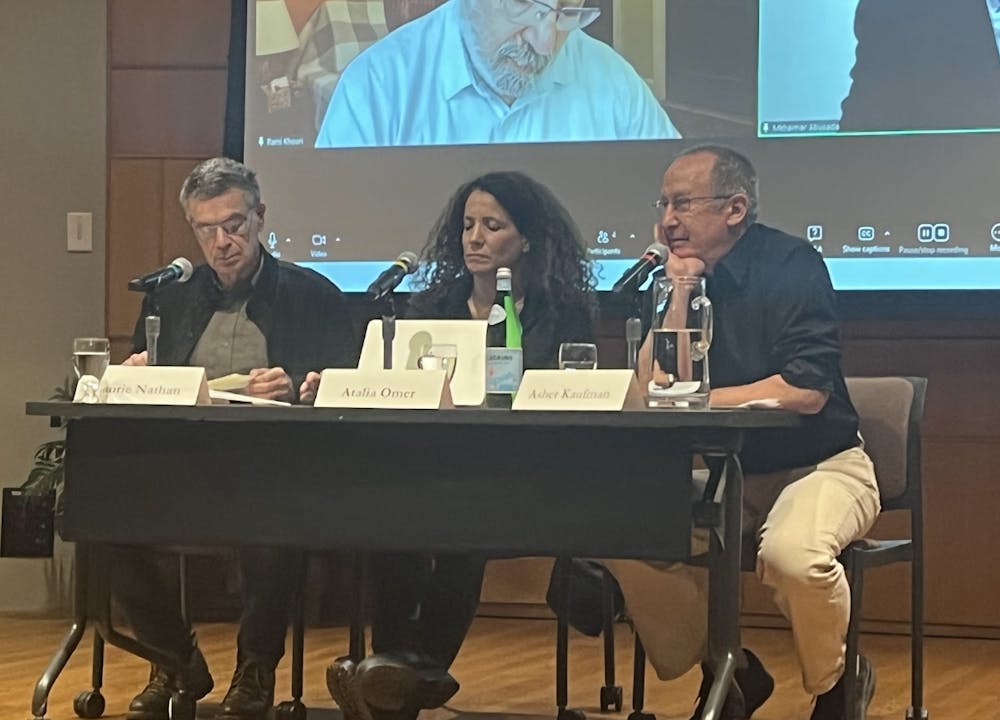
The Kroc Institute for International Peace Studies and the Keough School of Global Affairs hosted a panel about the ceasefire in Gaza on Thursday in the Hesburgh Center for International Studies. During the panel, professors Mkhaimar Abusada, Laurie Nathan and Atalia Omer examined the ongoing conflict between Israel and Hamas, primarily focusing on the humanitarian crisis in Gaza and the uncertainty surrounding the region’s future.
The panelists began by explaining the current status of the ceasefire deal between Israel and Hamas, which was proposed this month and continues to be overseen by the U.S. government. This ceasefire comes two years after Hamas’ initial attack on Israel on Oct. 7, 2023, where 1,200 people were killed, and 251 hostages were abducted.
According to the Council on Foreign Relations, the ceasefire means “all military operations, including aerial and artillery bombardment, will be suspended, and battle lines will remain frozen.” Additionally, the agreement calls for Israeli troops to withdraw from some of their territory in the Gaza Strip and for Hamas to release the hostages remaining from the Oct. 7 attack. In response, Israel will release 250 Palestinian prisoners serving life sentences. The United States also agreed to monitor the ceasefire and pledged to send “full aid” to Gaza “without interference.”
Long-term, the Trump administration laid-out a 20-point plan to demilitarize, stabilize and rebuild the area. According to CFR, the plan doesn't call for the establishment of a Palestinian state, although it does state that Israel will not occupy any part of the Gaza Strip in the long-term.
The panelists described the current ceasefire framework as “shaky” and “fragile,” with repeated violations by both Israel and Hamas. They also noted that while the ceasefire places most aggressive actions on pause, the humanitarian crisis in Gaza is still very much prevalent.
Specifically, Nathan, a professor of the practice of mediation, described the current agreement as “amateurish” and “deeply risky.”
He continued that “a good ceasefire assumes there will be violations” and must include “clear rules, monitoring and accountability.” According to Nathan, the Gaza ceasefire plan lacks the mechanisms to deter parties from actively violating the agreements.
Abusada, an associate professor of political science at the Al-Azhar University in Gaza, described the scale of the destruction in the region. “At least 70,000 people have been killed, and Gaza’s infrastructure — homes, schools, hospitals, mosques and water and electrical systems — has been almost completely ruined,” he said.
He continued that foreign journalists who recently entered Gaza “could see nothing but destruction and rubble,” as much of the area is completely flattened.
The human cost of the war is personal for Abusada. “I lost some family members in this war — my nephews, their mother and some of their little children,” he said.
According to Abusada, Al-Azhar University was one of the first educational institutions to re-open following the breakout of the war. The conflict has resulted in more than 80 percent of Gaza’s homes and civilian infrastructure being destroyed and 2 million Palestinians being displaced.
The panelists also described the various nuances and potential challenges of the negotiated ceasefire. The plan to resolve the conflict united a diverse coalition of nations, including the United States, Turkey, Qatar and Egypt, to pressure both Israel and Hamas to agree to the temporary ceasefire conditions.
While the framework for the ceasefire is largely in place, debates continue on whether the United Nations Security Council should send an enforcement arm to the region to monitor the ceasefire agreement and oversee efforts to deescalate the conflict.
The panelists concluded by focusing on the ways in which the conflict between Israel and Hamas is shifting dynamics in the Middle East region. New governments in Lebanon and Syria, as well as changes in Israel’s position on the world stage, have cemented the Gaza war as a global conflict rather than a regional one.
Factoring in these changes, the panelists agreed that Gaza’s recovery and long-term economic and political security remain uncertain.