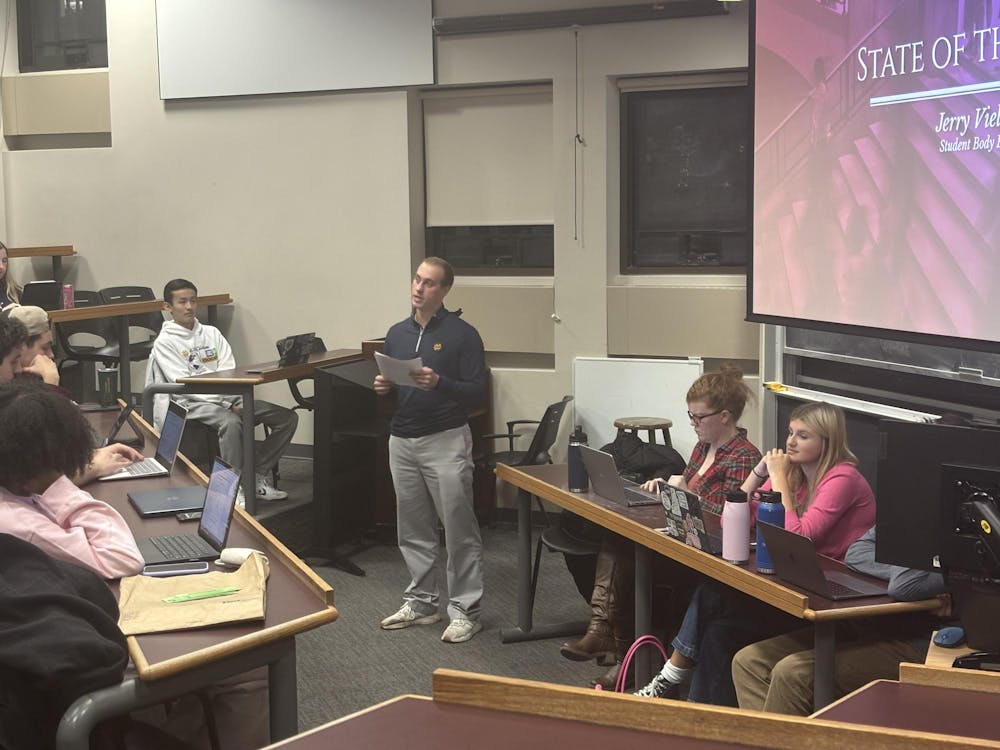
The senate met Wednesday and passed Senate Order 2526-13, a bill that simplifies removal proceedings for senate-approved officials. Student body president Jerry Vielhauer also gave his second State of the Union address during the meeting.
Vielhauer outlined several accomplishments of his administration, ranging from events such as wellness and civic engagement week to policy developments, including the introduction of new Grab and Go locations across campus. He also discussed ongoing election initiatives, including a $1,000 blank-check incentive for the hall with the highest voter turnout in hall, senate and presidential elections.
“I’m happy to announce every branch working hard on behalf of the student body,” Viehauer said. “I look forward to seeing that continue as we announce our intentions this year.”
After Vielhauer’s speech, the senate wasted little time moving into general orders, addressing SO 2526-13, a new piece of legislation introduced by senate parliamentarian Sam Robinson. The bill makes it easier to remove senate-confirmed officials. Its introduction was motivated by the current status of impeachment and removal proceedings, the challenging nature of which “makes it incredibly challenging to remove individuals for performance issues,” according to the senate order.
“Right now, there are a lot of insular positions to certain student union organizations that have a very long and drawn-out process for that individual to be replaced,” Robinson said. “In order for that individual to be removed from their position, they would have to go before the ethics council, and then would be entitled to a two-part process before the Senate.”
The primary concern for Robinson and other supporters of the legislation was that this lengthy process made the student government inflexible and unable to respond to performance concerns. SO 2526-13 mitigates the problem by removing the ethics council from the impeachment process for certain non-elected, senate-confirmed positions. The bill would not impact the removal process for elected officials, whether they be in the senate or class council.
“Judicial Council did a bylaw review at the end of last term, and … there were some questions about how certain individuals could be removed, and some constitutional discrepancy,” Robinson said. “For certain organizations where you do have more insular positions — like Judicial Council, vice president of operations, or an executive cabinet director — what should that process for removal look like and does it make sense that they’re entitled to the same process, like a senator is, if they’re not elected?”
Under the new guidelines, the executives of student union organizations can introduce bills of removal before the senate for individuals who hold enumerated or senate-confirmed positions within their organizations. The specific requirements for removal would derive from the body’s bylaws, which, under this legislation, would be set by the organizations themselves.
“Instead of taking a month, it [now] takes about two weeks to get rid of someone who might be negligent in their duties. This could be particularly pertinent for positions where there is a timeline, maybe VP elections, where if they’re not doing their job, they kind of need to get out, or else bad stuff will happen,” Dunne Hall senator Kyle Lauckner said in defense of the bill. “I feel pretty confident about this, because the biggest entity — the student senate — is still going to have a say whether or not the people leave.”
Not all senators supported the legislation. Badin Hall senator Madison Denchfield emerged as a vocal critic of the order, concerned about what it would mean for the ethics council to be removed from the impeachment process of senate-approved officials. According to Denchfield, only one senate-approved individual has ever been removed from their position by the senate. As a result, she failed to see how the bill’s necessity outweighed its potential cost.
“I see situations in which, if a branch has the power to issue a bill of removal for somebody without the oversight of the Ethics Council or an independent branch, people might be removed for personal disagreements,” she said. “The admission process requires something to be sent to the Ethics Council for a bill of removal to be issued. I think that that’s a good check and balance in place to ensure that an outside independent branch is leading the situation.”
Robinson responded by arguing that the agency of student union organizations to write their own removal bylaws would establish a clear and fair removal process, given that amending an organization’s bylaws requires a two-thirds majority and thus general consensus. He emphasized that each organization would decide internally what this process would look like before bills of removal could be sent to the senate. Robinson’s statements did not fully alleviate Denchfield’s concerns, however, as she still felt that the ethics council’s checks and balances were an essential component of the impeachment process.
“I just don’t think this is necessary, because we’ve only been in one situation where a person’s been removed by the Senate,” Denchfield said. “I think our existing process allows for checks and balances, and so I just don’t feel the need to adjust from that.”
After debate, the senate moved forward with a vote on the senate order. It passed convincingly, with Denchfield and four others voting against and three abstentions. After the vote, they concluded the meeting, adjourning for the last time until after Thanksgiving break.