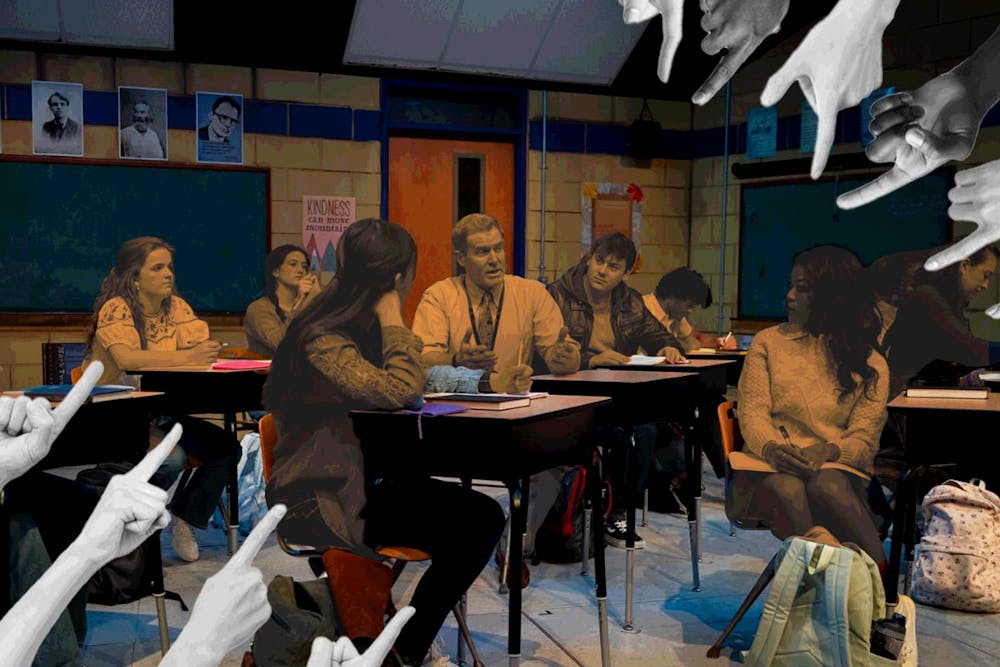
This weekend, the Department of Film, Television, and Theatre performed four sold out shows of “John Proctor Is the Villain,” a play that tackles contemporary themes and critical social issues like #MeToo, aiming to engage socially conscious audiences.
The play centers on a group of girls trying to start a feminist club in a small town in Georgia amid the #MeToo movement, and several prominent men of their city are accused of inappropriate behavior toward women.
We’ve all had a teacher like Carter Smith, who let us eat in his room during lunch and helped us found our clubs. In “John Proctor Is the Villain,” though, he’s also having inappropriate relationships with his students, and the club has to deal with the fallout when one of their friends, Shelby, comes back to town and accuses Mr. Smith of inappropriate behavior with her.
Jared Fernley’s portrayal of Smith was outstanding, especially when he finally snapped, creating a jarring, impactful moment that highlighted his acting talent and left a lasting impression on the audience, intensifying the scene’s emotional weight.
The decision to cast an older actor as Smith, contrasting with the clearly college-aged cast, is a deliberate production choice that gives the play authenticity and impacts how the audience connects with the story. Initially, I didn’t like Fernley’s performance: He came off as too wooden to me, but over the course of the play, he delivers some excellent moments, and when you finally see the professional facade break, it is genuinely incredible.
That isn’t to say the college-aged cast seemed less capable of acting — far from it. They gave my favorite performances. Caroline Mereness (Editor’s note: Mereness previously wrote for The Observer) delivers a fantastic portrayal of Shelby Holcomb, managing the darkness that she’s going through perfectly. Madeline Bendzick as the preacher’s daughter and burgeoning feminist Raelynn Nix and Esme Wickes as the neurotic teacher’s pet Beth Powell both delivered incredible performances. In less-experienced actors’ hands, these roles might have seemed one-note, but Bendzick and Wickes handled the roles with the grace they needed.
I also really liked Ethan Jones as Mason, a boy who joins the feminist club. I thought his character was going to be very one-note, but Jones added some very interesting and needed depth.
I was surprised to learn that the show was written in 2022 because it really couches itself in 2018, which sometimes made it feel a little dated. Specific lines reflect the culture of the period, making the dialogue feel authentic and adding depth to its social commentary.
The classroom set, with its highly realistic details like slightly scuffed linoleum floors, added authenticity to the black-box theater environment, showcasing a level of production quality that surpassed typical college efforts and enhanced the play’s realism.
The play shifted quickly from serious to silly. The cast navigated these shifts skillfully, avoiding jarring transitions and keeping the audience engaged.
The play explores #MeToo with nuanced care, effectively portraying the complex feelings when a trusted figure is accused, thereby highlighting the production’s relevance and impact. It could have been easy to make the material feel like a lecture. Still, the cast handled this complex subject matter amazingly and delivered an incredible performance that made this a triumph for the department.