
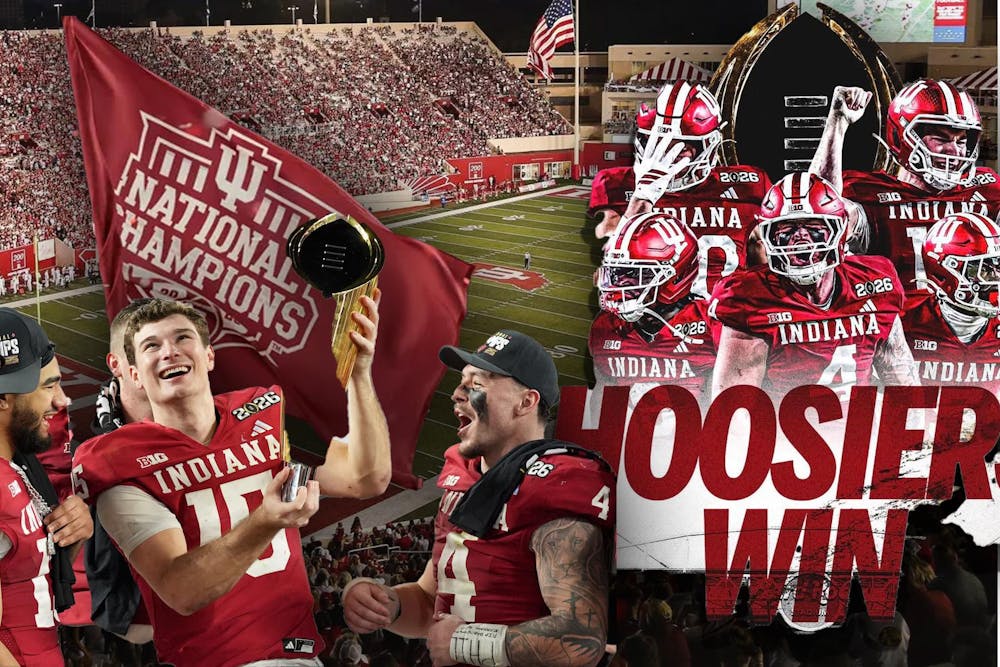
“It all feels like a movie. To finally have [our] championship aspirations realized is so special.” This was IU Bloomington freshman Noah Yoon's reaction after Indiana’s historic championship win on Jan. 19. Yoon comes from a family of IU alumni, and while this victory meant a great deal to him, it meant even more to his father.
Reflecting on what the win meant to his dad, Yoon remarked, “He has been a Hoosier fan for basically all of his life. [He lived] on campus for 18 plus years, yet he has only seen our football team be the losers of the Big 10 and the nation at large. To see this historic turnaround climax in the biggest win of all, I know it meant more [to him] than I can imagine.” Many members of Hoosier nation in Bloomington and beyond likely felt the same on Monday night.
While this is a far cry from the topics I usually cover, as a born and raised Indiana Hoosier, the twin sister of an IU student and the daughter of an IU Med School alumnus, it would be impossible to ignore how Indiana’s championship has reshaped college football. IU’s title demonstrates that success no longer belongs to the wealthiest programs or those stacked with five-star recruits. Instead, it belongs to teams who are “never daunted.”
This Wasn’t a Fluke
Indiana entered the 2025 season as the most-losing program in the history of college football, yet they finished as national champions. Many have described Indiana’s historic run as a “Cinderella story.” The reality is no fairytale; luck was involved in their success. Indiana is a product of grit, faith and an unwavering commitment to fundamentals. Most importantly, it required a coach who understood that leadership and consistency breeds champions.
It was because of Coach Curt Cignetti’s emphasis on the fundamentals that in 2025 the Indiana Hoosiers found themselves as the most mistake-proof program in the nation. In the first quarter of the IU vs Old Dominion game, Indiana running back Lee Beebe Jr. fumbled the football, this Indiana’s only fumble for the rest of the season. As of Jan. 6, the Indiana receivers had dropped just six of quarterback Fernando Mendoza’s 332 pass attempts. There are countless other statistics that support Indiana’s near perfect gameplay which made them so successful.
What makes these numbers so striking is that Indiana’s roster is full of overlooked talent. The Hoosiers used the transfer portal to bring in players who were diamonds in the rough. Heisman winner and star quarterback Fernando Mendoza was exactly this, a diamond in the rough. Mendoza was a two-star recruit and the 182nd ranked quarterback in his class. While he had found some success in California, he believed that “Indiana was the best place for [him] to make that jump developmentally” and position himself as an NFL draft prospect. It‘s safe to say he made the right choice.
The Business of College Football
Indiana‘s title is a culmination of so many right choices, but it also marks a new beginning for the business of college football. Conventional wisdom once held that only elite programs with decades of history, an abundance of championships and ever-flowing resources could survive in the college football world, let alone become national champions. IU’s success is forcing college football fans everywhere to reevaluate what success looks like in this sport. Moreover, it is forcing teams everywhere to learn how to use transfer portals and NIL policies to their advantage.
After the 2021 NCAA ruling on Name, Image, Likeness (NIL), college athletes found themselves able to profit off their NIL for the first time. This decision came with a lot of push back from fans and programs alike who claimed players making NIL would only over-commercialize the sport. The reality is, college football was always a business. Conferences sign multi-billion dollar broadcasting contracts all the time. The Big Ten’s 7-year, $7 billion media rights contract is just one example.
While the NIL played a role in IU’s success, ultimately it was Cignetti’s expert use of the transfer portal that built the championship-winning wonder team. Cignetti bringing 13 of his James Madison University players to Indiana was a controversial move, with many saying that it gutted JMU’s program. However, the transfer portal gave these players a rare second chance. Experienced and overlooked, they found an opportunity to compete for a national title and redefine their careers.
Changes in NIL spending and transfer portal regulations have not eliminated inequality in college football. Glaring financial disparities still exist, and NIL has introduced new debates about wealth disparities. However, the ability to succeed has shifted away from historic superteams and has allowed fresh faces to enter the conversation.
Equity and Opportunity
Contrary to the previous parts of this article, “Off Notre Dame Ave” is not morphing into a sports column. Indiana’s win matters because it is not just a sports story, but a story of overcoming inequities and breaking the glass ceiling in college football. IU’s team is riddled with stories of overcoming adversity. Mendoza is the first Cuban American Heisman Trophy winner and third Latino winner in college football history. In a time where Latino communities in the United States are being hatefully targeted, displaced and disrespected, I can only imagine what it means to see a Latino quarterback lead a team of misfits to a national championship. Mendoza has never been afraid to share his Latino heritage with the world, and now more than ever it is important he wears his Cuban American identity with pride.
Indiana’s win is indicative of an era of college football that is less reliant on stars or numbers or stats, but potential for excellence. When discussing his recruitment to James Madison University, defensive lineman Mikail Kamara said, “They do a great job of watching film and not just looking at rankings or stars … That’s what a lot of coaches need to start doing; look at the tape.”
Coach Cignetti has always been open about the impact his Indiana team has had on college football saying, “I think we sent a message to society that if you keep your nose to the grindstone and work hard, you’ve got the right people, anything’s possible.”
Indiana’s win starts a conversation about equity in college football. Equity doesn’t mean that every program will go on a generational run like the Hoosiers. It does mean that doors will open for those who have been overlooked and underestimated. It means that success is no longer reserved for a predetermined few. Media surrounding college football often reinforces a hierarchy that portrays certain programs as more deserving of success than others. Commentators throw around stats and historical evidence to “prove” the excellence of certain teams. Indiana shows that the past is not indicative of the future. Sometimes in order to win, you must disrupt the status quo; you must take chances that no statistic supports because the higher the risk, the higher the reward. As a college football fan, I hope coaches across the country take a second look at their recruiting class and see the potential in players no one else sees.
What this means for Notre Dame
As Notre Dame students and Fighting Irish fans, it is easy to see IU’s win and feel discouraged. If Indiana has won a national championship in the 21st century, why hasn’t Notre Dame? To this I say have patience. Hoosier fans waited 140 years for one national title. Notre Dame is blessed with eleven.
The Fighting Irish are not lacking in grit, work ethic or resilience. Like Indiana, Notre Dame has an intelligent, seasoned coach at the helm. It has never been a question of if Notre Dame will win its twelfth national championship but when.
If you take away any lesson from Indiana’s win, it is that we must continue to bide our time and have complete faith in our team. While I’m the sister, daughter and friend of Hoosier fans, it will always be Irish by a trillion for me.
Thea Bendaly is a freshman from Carmel, Ind. living in McGlinn Hall. She studies political science and romance languages and is a member of the Glynn Family Honors Program. In her free time, you will find Thea crocheting in her dorm, singing with Halftime A Cappella or hanging around with friends. Please feel free to contact Thea at tbendaly@nd.edu as she looks forward to hearing your thoughts (good or bad) about the column.


