
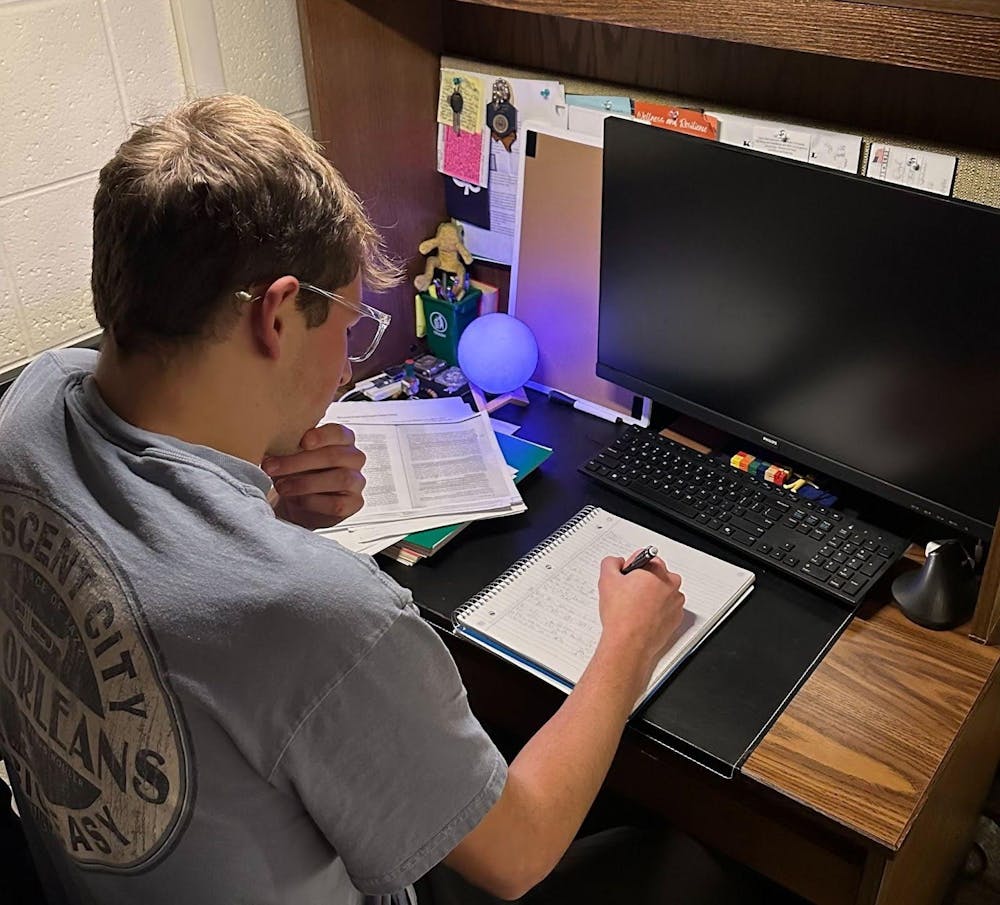
I’m an engineer by trade, or perhaps by education, since I’m still unemployed. Yet despite the relief I feel after solving a particularly convoluted physics problem or logic gate diagram, I feel a much more notable sense of fulfillment upon the completion of a writing piece. Whether it be the technical reports associated with many a freshman engineering course, my biweekly column here with The Observer or an occasional voluntary article I’ll submit to the Wall Street Journal, writing has found its way into every corner of my life. Eventually, it will for you as well, no matter the major you choose.
Countless students, even some of my peers at Notre Dame, lose the forest for the trees in the pursuit of single-minded potency. It’s tempting to deride the English majors in your friend group for their supposed projected unemployment due to a lack of some sort of technical ability, but in actuality, the diverse skillset and applicability, particularly from a Notre Dame degree, prove to be continuously valuable. In truth, employers have found time and time again, especially with the evolution of the internet, that it is easier to teach a humanities major the fundamentals of C++ than it is for an engineering major to learn how to present technical concepts effectively to shareholders. Some might say that this is why a Mendoza major is really only the degree path you’ll get any return on investment from at ND, but, at risk of alienating half the student body, business majors are generally an even more potent example of hyper-specialization (just listen to any of your upperclassmen friends talk about investment banking interviews and you’ll see what I’m talking about).
It’s not hard to hear what top employers look for in candidates, and with Meta’s introduction of AI into technical interviews last year, your technical abilities are only half the picture. The workplace is not the ultimate focus of this article, however. You should be excited to write for yourself, even if the reason you are writing is a class assignment in and of itself. No matter the assignment, there’s always an inherent personal tilt to your end product. Beyond the fundamental building blocks of spelling, grammar, and general syntactic structure, it’s not really possible to pinpoint what a “correct” essay looks like. Certainly, there are oftentimes multiple ways to solve a calculus problem, but the multivariable nature of writing yields a far more diverse range of outcomes. In a way, you can’t really even describe a piece of writing in response to an assignment as a “solution”, as this term implies that same sense of correctness that is not necessarily an inherent part of essay writing. Ultimately, the writing process, whether it be for your own pursuits or to check the box of an assignment, is fine-tuned to your own perspectives and style, and thus becomes a representation of the self in a far more meaningful way than the completion of a physics free-response problem.
In short, as we begin the long trudge that is the segment of the spring semester before spring break, I think you’ll find value in taking pride in your writing. Look at that history paper not as a chore prohibiting you from extracurricular activities, but rather as a supplement in and of itself, one demanding your full attention. Inevitably, your end product will be better than if you were only focused on word count, or God forbid, had to resort to AI to write for you. Writing is an artistic venture, and, truthfully, is a more complete manifestation of the self compared to visual or sensory mediums. Robbing yourself of the chance to express yourself, even putting aside AI, can only be a net loss for your psyche. Consider where you’ll be in five, 10 or even 20 years’ time. Do you think you can bet on “rediscovering” your true self then, or can you set the foundation now for how you know and perceive yourself? This may seem like a grossly high-brow perspective as it relates to that English essay you’ve been putting off for a week now, but it really is that important. In a world where others’ perceptions dictate so much of our lives, take agency in what you can and everything else will follow.
Michael Doyle is a freshman from Haddonfield, New Jersey living in Knott Hall studying computer engineering. When he's not rehearsing his violin for the campus orchestra, he's spending his paycheck at a farmer's market or playing golf. He eagerly awaits any discussion you want to bring forth at mdoyle25@nd.edu.


