
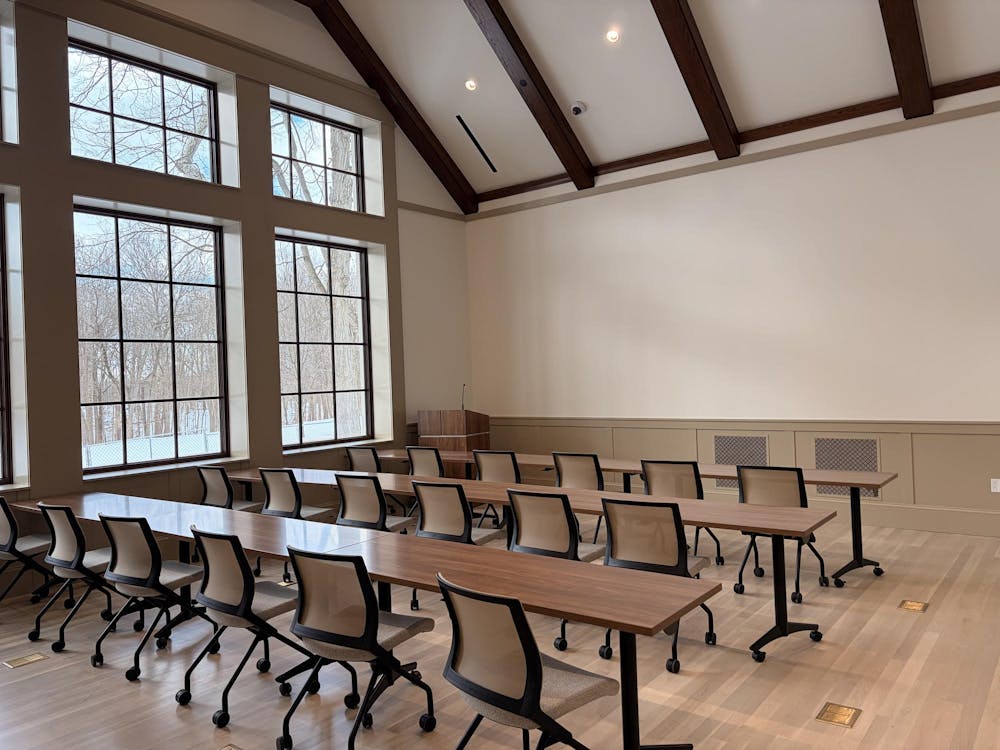
Construction continues along The Avenue at Saint Mary’s on the Heritage and Research Center (HARC), an archive that will focus on the preservation of the history of religious sisters and allow the women religious of Holy Cross to tell their story.
Jennifer Head, congregational archivist of HARC, has been working on the project from the very beginning. She was there in 2018 when the Sisters of the Holy Cross presented their idea for an archive to ten congregations as a way to manage their records after they are no longer here to take care of them. With fewer and fewer young women joining the order, the sisters are “coming to completion” and have turned to a new solution for maintaining and sharing their history.
The completed center will offer a broad range of data for researchers to examine. Barbara Gordon, executive director of HARC, explained the many types of files the HARC will store.
“Each congregation, of course, kept personnel files of all the sisters who joined, and there’s information about their lives in there, but there’s also robust data about all of their ministry work,” Gordon said. “So school records, hospital records, farming records, social justice [and] social justice work.”
Head further explained that the Sisters of the Holy Cross is a business, and records relating to the management of the company will also be stored in the center.
Construction of the HARC building should conclude in roughly four to six weeks. Then, Gordon and her team will begin the long process of moving everything into the official center. An opening ceremony will take place in May for congregations members, and open houses will occur in June. The center will not be open to students until sometime next fall, Gordon shared, with the hope that classes will be able to come and visit.
Until then, the HARC staff will be sorting and organizing all of the records the building will store — a process that will extend well into next year.
“Right now, none of the archival collections are in the building, so that’s our next big project. All ten of [the] archives from all over have to get loaded onto a truck and they have to get moved to us. And then, there’s a whole process where we have to inventory things and examine things before we can [store] them in the vault,” Gordon said.
Additionally, a major hope for the HARC project is to create a digital archive with files from across the country, all accessible in one place. The Saint Mary’s center is one of four hubs in the United States focusing on this project, along with one at Boston College, one at Santa Clara University and an independent center in Cleveland, Ohio. Data from each center will hopefully be synthesized on a single site.
The HARC team’s greatest hope for the center is that it will be an intersectional learning hub for students and professional researchers to explore the history of Catholic religious women. Gordon anticipates students from a wide variety of subjects (nursing, science, education, history and humanities) to conduct research and use the resources it provides to support their scholarly pursuits.
“It’s rare for undergraduate students to have the opportunity to use primary source resources and archives in their undergraduate curricula. Usually that’s a graduate school kind of thing. And so we have a lot of professors who are really eager to make that option available for their students,” Gordon said.
Head agreed, saying, “People don’t realize the depth of research and resources that are available in these congregations, and how much impact these women have. They are truly hidden stories, you know. You have sisters who were instrumental in the founding of Alcoholics Anonymous. They’re instrumental in founding hospice programs. The first woman in the United States to get a Ph.D. in computer science was a Catholic sister. So there were all of these hidden stories that are, you know, begging to be told. And I think the students are really gonna have a fun time getting to know these stories and finding all this hidden history.”


