
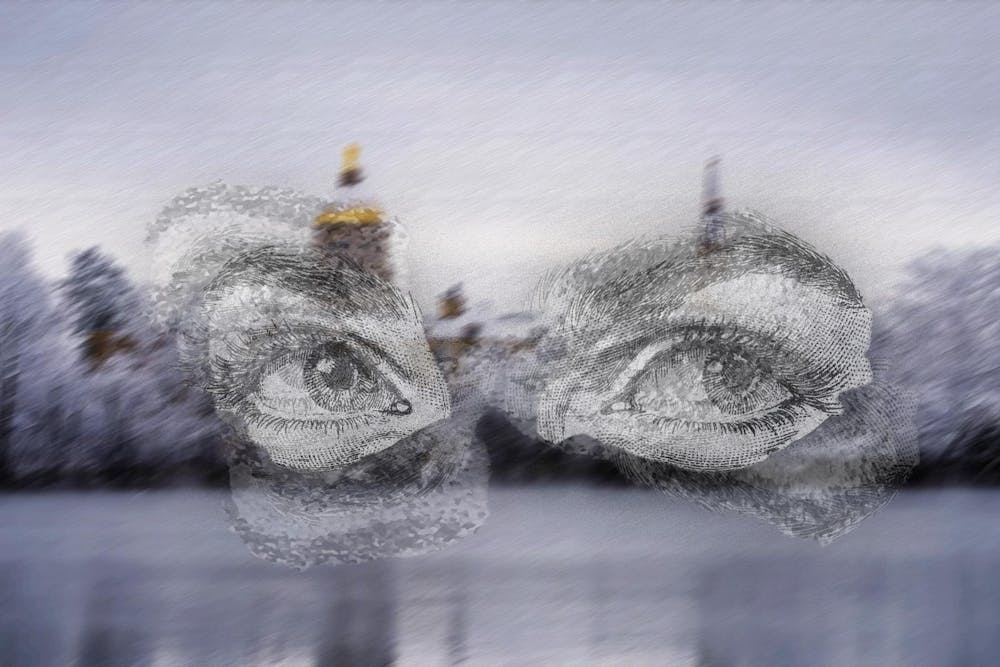
“See me, the blind girl standing tall, not alone. See me and my mother, holding onto each other, rebelling together, our bodies shaking with laughter, our hearts contained in a world of our own making.”
I still remember the dark shape of her, standing between the window and my eyes. I can still feel the nauseating weight of her silent gaze.
I was alone that day, in my mother’s office, taking my 11th grade final online.
My mother’s colleagues walked in and out of the room. I heard their footsteps; most of them introduced themselves with light and hurried smiles.
I continued to sit at a desk, resolutely working on my essay. Perhaps it was when I lifted my head to gather fresh ideas from the ceiling, that I noticed that her shape was blocking the window.
She stood very few inches away from me, unmoving, silent. My eyes, which are perceptive to light and shadow and large objects, made out her shape framed against the window, but told me nothing else. I don’t know why I even continue to believe that it was a woman, but I knew what this unmoving silence was about.
She was testing me. She wanted to know how much the blind girl could actually see. Or she was staring at me, the girl with the monstrous eyes. How am I so sure of this? Because this is not the first time that something like this has happened to me. The first time is so far back that I can’t even remember it.
What I remember are fingers held up two inches from my eyes, dancing shadows with waving hands. What I remember is my parents telling me about people who stood still and simply stared. What I remember is the children vocalizing their stares into screams of terror.
These memories clog my throat as I sit in the lonely silence of that room, the woman still looming over me, staring, willing my eyes to respond. The angry part of me wants to slam my fist down and say, “What do you think you are doing!” But the other part of me, the part that cannot even trust my eyes, the biggest part of me that just feels numb, wants me to become invisible. So I choose the middle-ground. I school my face into a mask of rigidity. I keep my stare blank. I pretend that the looming shape does not exist, that it’s just me in that silent room filled with the light from the windows. She continues standing for a few moments, then finally leaves.
When women got tired of constantly feeling burdened by the invasive eyes of men, they coined the word “male gaze.” And in doing so, they made the act visible, bringing attention to the disgust and anger that it had avoided until then.
If there is such a thing as a “male gaze,” what am I the victim of? An “ableist gaze”? Is there even such a thing? I don’t know if there is, but I certainly feel it, even in its absence.
The idea that I am a strange object that draws attention is something I internalized as a child. As a little girl, I would walk into a crowd, and just know that people were staring at me. Perhaps my knowledge was just assumptions, but tell that to a six-year-old who had felt the pressing weight of real eyes so many times that she could no longer separate the real from the unreal. Even now, on my worst emotional days, when I am most vulnerable, I feel the invisible weight of a thousand stares. In those moments, I just want to close my eyes tight, as though the act of shutting out the world will magically make me disappear.
But growing up has taught me that I cannot afford to be silent. Fighting for myself is a necessity that I must embody to survive, to make myself heard in this world. But what must I do when rebellion feels like the hardest, most impossible thing?
I do have a few memories of the times I rebelled. But they give me no sense of triumph, not even a sense of quiet steady peace. Almost every time I spoke up against someone who invaded my privacy, I was met with explanations, justifications and sometimes even anger because I dared to feel hurt when they were simply being “friendly” or “curious,” when they “just wanted to know more about me.” If rebellions are about taking back power, why do I feel so drained at the end? Why do they get to walk away without even an apology, leaving me with irrational guilt, because what if I was overreacting? What if I made them uncomfortable?
All these times I spoke up, I felt so alone. The people around me went on laughing and talking, as pain flared from my body in waves. My open wounds were so invisible to them that it made me wonder if all that I felt was nothing. Why does no one tell you that rebellion is often a desolate thing?
There isn’t going to be an end to this story, to these violent stares of apparent curiosity. And I really don’t know if there will ever be a time when rebellion will feel easy. Perhaps this time will indeed come. I am only 22, after all.
But what do I hold onto for strength in the meantime?
Perhaps this memory?
Amma and I stand on the escalator together. “Hannah, there’s a man who has been staring at you for a while now,” she says.
Both of us know that he is not staring at my girl-woman’s body, but at the strangeness of my blind eyes. Looking at the surprising, even shocking presence of my disabled body in a crowded shopping mall full of non-disabled people.
I feel anger flood my body in waves. Beside me, I feel my mother radiate red heat.
“I want to do something!” I declare, buoyed by our shared rage.
We turn toward each other like conspirators.
“I want to stare back at him!” I say.
“OK! Hannah, he’s right behind you. On the count of three, turn back and give him the hardest, angriest stare you’ve got! One, two.”
“Wait, wait! I’m not ready. I want to practice with you once.”
“OK, show me.”
I turn to her with bulging eyeballs, and an intensely wrinkled up forehead. But there is a strange, bubbling lightness to my body that pushes the anger away into small corners.
The silence is shredded by peals of laughter. “Hannah, that is not how you stare angrily at someone!”
I can’t help it. My face crumbles, and my lips twitch upwards. Finally, the anger leaves my body with the lightness of laughter.
Everything is so ridiculous now, the man and his stupid stare. My mother and I float buoyantly. Our laughter makes us feel cool, powerful.
At some point, I remember the strange man, and I think, “See me now, the blind girl, living, taking up so much space, making herself at home where she does not belong. See me, the blind girl standing tall, not alone. See me and my mother, holding onto each other, rebelling together, our bodies shaking with laughter, our hearts contained in a world of our own making.”
Hannah Alice Simon was born and raised in Kerala, India, and moved to the U.S. for college with the dream of thriving in an intellectual environment that celebrates people with disabilities. On campus, you will mostly see her taking the longest routes to classrooms with her loyal cane, Riptide, by her side. She studies psychology and English with minors in musical theatre and theology. You can contact Hannah at hsimon2@nd.edu.


