There’s a concept in economics called an “opportunity cost.” It’s the potential benefit that you give up when choosing one alternative over another.
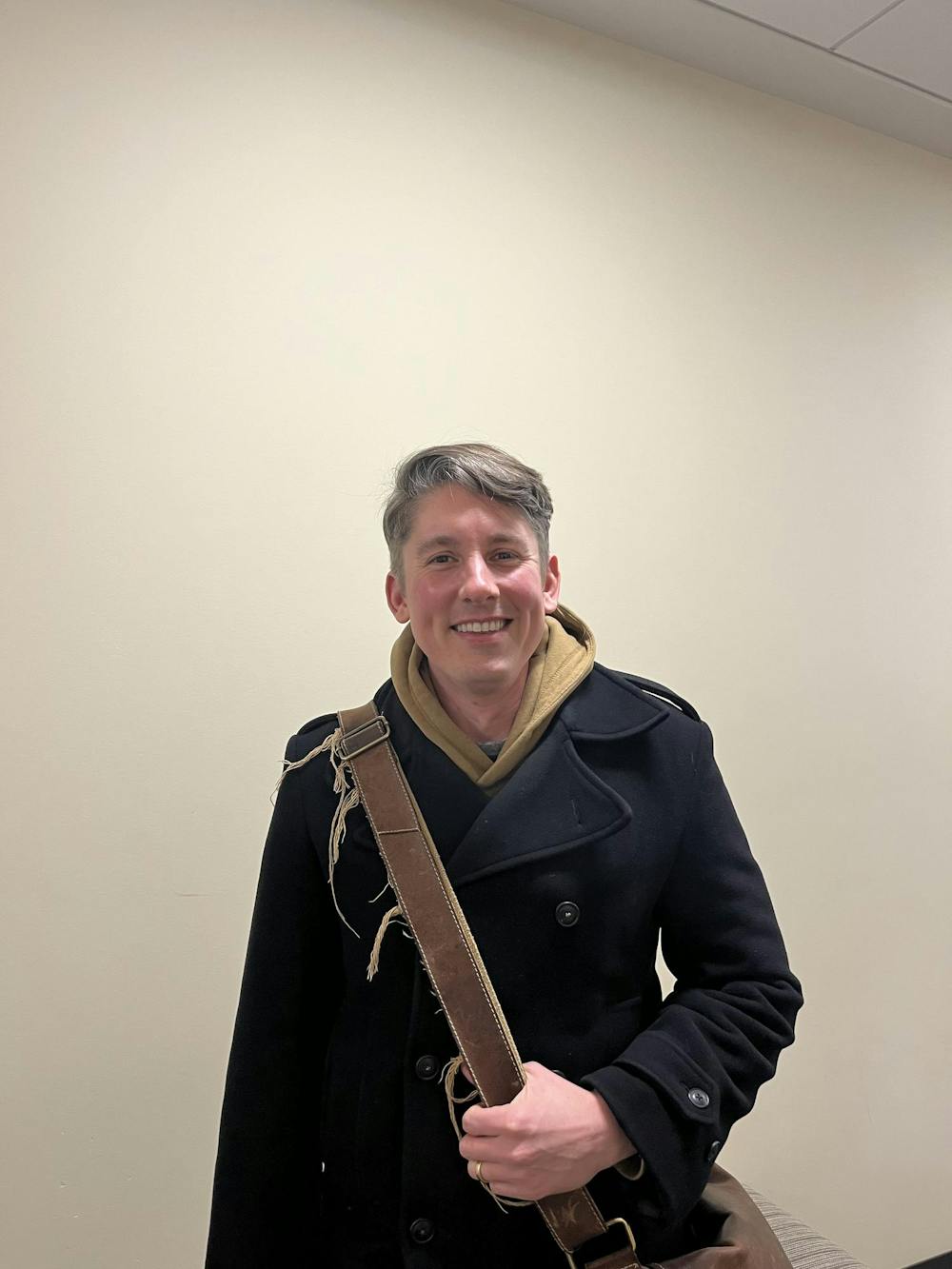
I weigh the opportunity cost of conducting this interview as I walk to Jenkins Nanovic. It’s 0 degrees on an early Friday morning — every step from my car feels like an irrational tradeoff from the warmth and comfort of my bed. But as soon as I arrive at Professor Forrest Spence’s office, I know I made the right choice.
A legend for anyone familiar with Notre Dame’s economics department, Forrest Spence is known for memorizing every one of his students’ names — no small feat for someone who fills the largest lecture hall on campus, DeBartolo 101, with multiple sections of Principles of Microeconomics every semester.
Curious how he remembers so many faces, I ask Spence to show me just one of his class rosters. He pulls out a packet containing 80 students’ pictures, full legal names, majors and hometowns. “It might be a little creepy,” he laughs, “but it’s low-hanging fruit … [it lets students know that] someone’s paying attention, someone actually knows your name.”
Although the economics professor also serves as the director of undergraduate studies for the economics department, being in the classroom with students is his favorite part of his job. “I like being around people when they’re learning new ideas. You get to see these light bulb moments” he explains.
In fact, he knew from an early age that he wanted to be a teacher. “I went to a Montessori school, [where] there’s a lot of student teaching that goes on.” Wanting to pursue this love for mentorship, he decided to study math in college and become a high school math teacher.
But upon arrival at the University of South Carolina, his path didn’t go exactly as planned. “I flamed out in very spectacular fashion,” he laughs. “My first fall semester, I made it, like, maybe eight weeks.” This flameout led Spence to a year-and-a-half stint working as a warehouse employee.
While most Notre Dame students would break out in hives at the thought of such a detour, Spence had an amazing time. Getting to drive a forklift and live at home? “It was the richest point I’ve ever been in my life,” he laughs.
But eventually, the value of a degree outweighed the benefits of a warehouse paycheck, and he decided to go back to school. There, he took an economics course that made him realize he could actually apply math and got him thinking about Ph.D. programs.
“I was an average math major at University of South Carolina, which is not a great signal that you should do a Ph.D. in math,” he joked. Yet, coming from a family that prioritized continuous learning — having a dad with a Ph.D. and a mom who’s still taking classes at 75 years old — made the Ph.D. path a natural transition.
At the end of his doctoral program, Spence’s adviser suggested he look at universities for tenure-track professor positions. But after a few failed job interviews, Spence was stumped.
That’s when someone told him about an open lecturer position at Notre Dame.
While both provide the title of “professor,” Spence explained that there’s a difference between tenure-track and lecturer, or “teaching professor,” positions. Because tenure-track positions usually require a Ph.D. and the production of research each year, they are generally higher-paying and considered to be more prestigious. Plus, gaining tenure means securing a job for life.
Lecturers or teaching professors still instruct students, but do so without necessarily needing a Ph.D. and/or having to produce research papers.
Spence found himself with a classic opportunity cost dilemma: apply for the lecturer position at Notre Dame or wait for a tenure-track role somewhere else? Traditional economic logic would tell him to maximize his financial opportunity: the tenure-track position. Choosing the lecturer position would mean missing out on a certain level of status and pay. However, it would allow him to do what he ultimately valued: teaching.
Now a teaching professor at Notre Dame 11 years later, Spence clearly made the right choice. He has a job that allows him to combine his love for economic theory, lifelong learning and mentorship. “I decided to get off this prestige train and not follow people’s advice. I knew more about me and what made me happy and what I wanted than anybody else,” he explained.
Maybe that’s why the economics professor hates giving out advice. “When it’s too heavy-handed, [advice] is sort of counterproductive … You know yourself more than anybody else on the planet.”
Spence exemplifies what being a teacher is all about. He isn’t just teaching micro — he’s teaching students how to navigate life. He’s teaching them how to calculate what they value and have the confidence to choose the “best option” for themselves, even when the world suggests otherwise.
Allison Elshoff is a senior business analytics major with minors in the Hesburgh Program of Public Service and impact consulting. Her top three things to exist are hammocks, outfit repeating and mini spoons. You can reach her at aelshoff@nd.edu.