
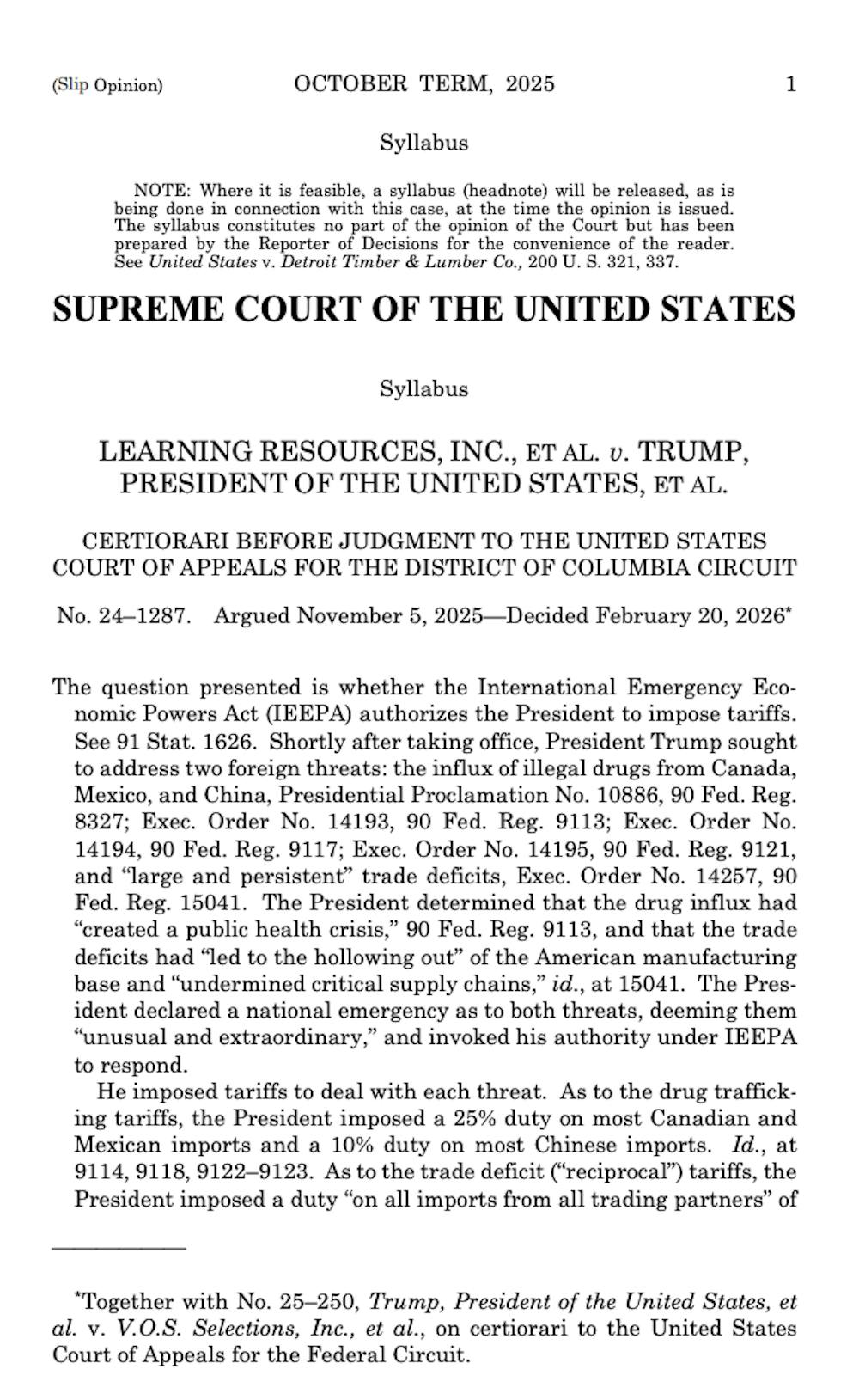
On Feb. 20, the Supreme Court released a decision on tariffs instituted by President Donald Trump under the International Emergency Economic Powers Act. In a 6-3 ruling, the court held that the president does not have the authority under the act to unilaterally issue tariffs. Notre Dame professors in the departments of political science and economics reacted to the decision and discussed what they believe may occur in the near future as a result.
The International Emergency Economic Powers Act, enacted in 1977, authorizes the president to “regulate a variety of economic transactions following a declaration of national emergency.”
In its opinion, the majority quoted the Constitution, which states, “The Congress shall have Power To lay and collect Taxes, Duties, Imposts and Excises.” Chief Justice John Roberts authored the opinion, joined by Justices Sonia Sotomayor, Elena Kagan, Neil Gorsuch, Amy Coney Barrett and Ketanji Brown Jackson. Justices Gorsuch, Barrett, Jackson and Kagan also wrote concurring opinions.
Justices Clarence Thomas and Brett Kavanaugh dissented. Justice Samuel Alito joined Kavanaugh’s dissent. Robert C. Johnson, the Brian and Jeannelle Brady associate professor of Economics, noted that taxation authority rests with Congress.
“Congress remains the big question mark — it is endowed with taxation power, including authority over tariffs,” Johnson said in a statement to The Observer. “It has delegated limited powers to the president through various laws over time, and it has taken back some of those powers in the past.”
Richard Clark, assistant professor of political science, said the ruling may not dramatically shift trade policy in the short term.
“In the short run, I don’t expect the Supreme Court’s decision striking down the administration’s IEEPA-based tariffs to dramatically alter the trajectory of U.S. trade policy,” Clark said in a statement to The Observer. “Before the ruling, the administration had imposed a 10 percent baseline tariff on most countries, with higher rates up to 50 percent for high trade deficit countries, pushing the average effective tariff rate to around 17 percent, the highest level in roughly 90 years.”
Clark noted that immediately after the decision, the average rate would have fallen to roughly 9%, but the White House has already moved to impose tariffs through other legal mechanisms, including Section 122 of the Trade Act of 1974 and Section 232 national security provisions.
“As a result, the ruling seems more of a legal detour than a policy reversal,” Clark said.
In recent days, Trump announced new duties at a 10% rate for goods entering the United States from foreign countries. He has also signaled that the rate could increase to 15%, though that figure has not yet been formally published.
Johnson said there was initial confusion about the new surcharge.
“There was some confusion about what the new surcharge would be, 10 versus 15 percent, but the executive order came into effect today with the 10 percent rate,” Johnson wrote. “Section 122 authorizes a time-limited tariff surcharge of up to 15 percent, which allows the president to manage fundamental international payments problems, including balance-of-payments deficits, prevent depreciation of the dollar or coordinate with other countries on payment issues.”
Eugene Gholz, associate professor of political science, said the administration is complying with the court’s ruling while pursuing alternative authorities.
“The president is obeying the Supreme Court ruling in that the IEEPA tariffs are no longer being enforced,” Gholz said in a statement to The Observer. “Instead, the president has announced new temporary tariffs using another dubious authority. The new tariffs are at a lower rate than the previous tariffs under IEEPA, and they can only remain in force for a short time, so there may not be time to fully litigate them before they expire.”
The United States’ history of tariffs began early in the nation, with the Tariff Act of 1789, known as the Hamilton Tariff, being a primary early example of taxation on a large quantity of imported goods.
Tariffs have played a significant role in U.S. economic policy since the nation’s founding. The Tariff Act of 1789, often called the Hamilton Tariff, marked one of the first major federal revenue measures. The Tariff of 1828, sometimes referred to as the Tariff of Abominations, imposed rates between 38% and 45% and sparked intense political opposition.
Protectionist policies continued through the late 19th century, including the McKinley Tariff of 1890. After the ratification of the 16th Amendment in 1913, which established the federal income tax, tariffs became a less central source of government revenue. The Smoot-Hawley Tariff of 1930 marked another major protectionist shift. Broad tariffs reemerged during Trump’s first administration.
Johnson said Congress should reclaim tariff authority.
“My view is that it should take those powers back up now,” Johnson said. “It is time for a good and robust public debate about how the U.S. wants to engage with the rest of the world on trade, tariffs and other foreign policy fronts.”
He added that while the president can seek congressional authorization for tariffs, the administration appears to be relying on temporary measures while considering longer-term strategies.
Clark also emphasized the economic impact of tariffs.
“Economically, tariffs are largely borne by Americans,” Clark said. “Research suggests roughly 90% of the cost is passed through to U.S. firms and consumers, with estimates of around $1,300 per household in 2026 if current policies persist.”
While both political parties have adopted more protectionist positions in recent years, particularly in response to China, Clark said broad tariffs remain a costly policy tool.
“So while I don’t expect a return to the pre-2016 free-trade equilibrium anytime soon, policymakers would be wise to consider more targeted tools, such as investment incentives or subsidies that encourage domestic production, rather than relying primarily on tariffs,” Clark said.
Gholz said the courts face limits in constraining presidential power and that Congress is unlikely to intervene.
“Even if Congress passed a bill to restrain the president, the president would generally be able to veto that bill, and Congress cannot come close to overriding such a veto,” Gholz said. “The real potential check on overextension of presidential power is the public — a drop in the president’s approval rating or sanction at the ballot box on Election Day.”


