
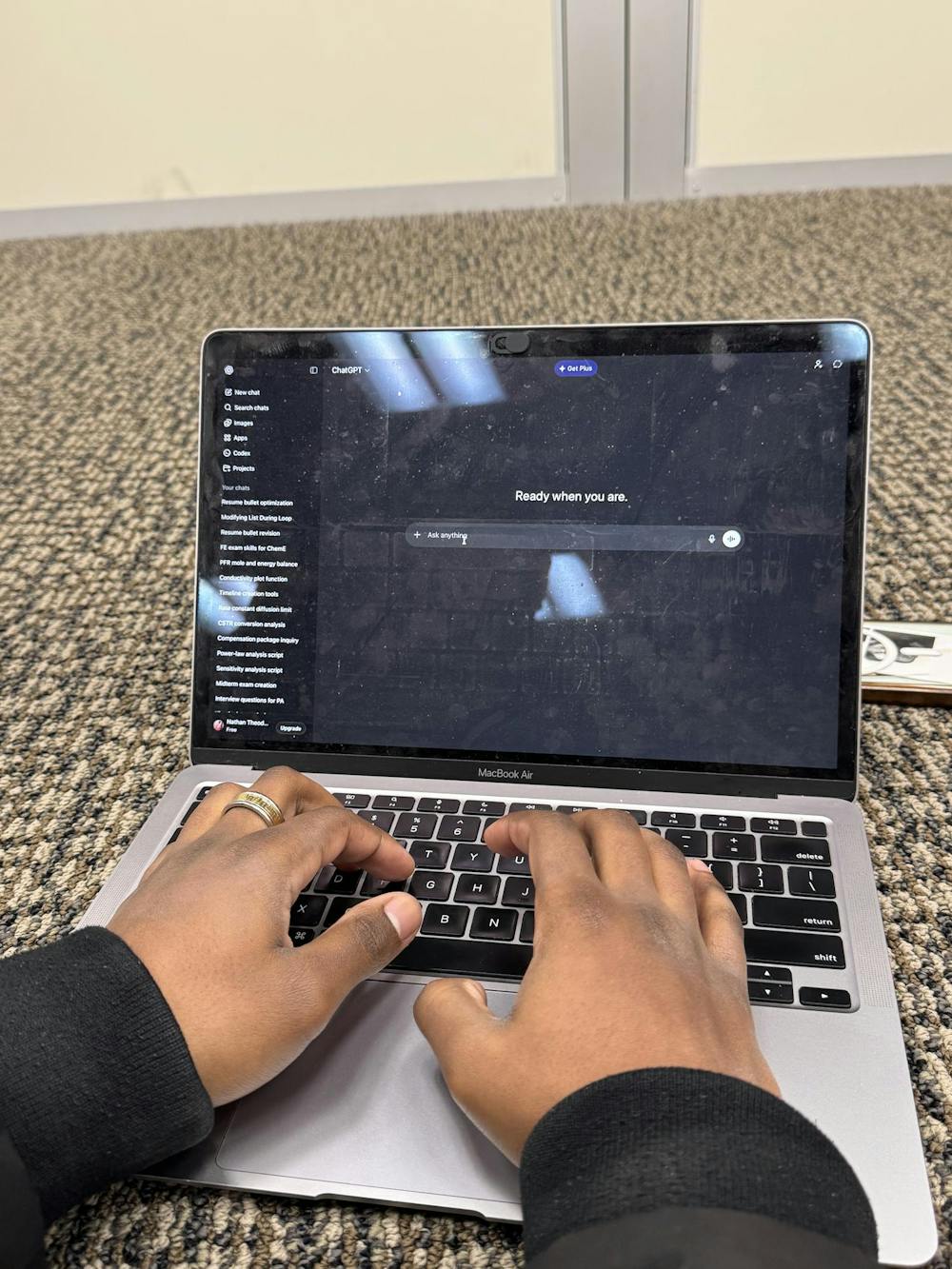
Since the beginning of the academic year, I’ve spent many Sunday afternoons curled up in a chair at Hesburgh Library. I choose a different spot every time, but I always prefer sitting in a quiet corner with my back to the wall. From there, I can look out at the sea of studious activity from time to time and observe as work is completed, lessons are learned and progress is made. It gives me a sense of purpose and pride to think of myself as a cog in this large machine of intellectual enterprise (and it keeps me on track when my eyes start wandering from my work). But sometimes I am unnerved, upon surveying the scholarly scene, at the number of laptops I see open to the same tab: ChatGPT.
Although I can’t see that closely, I am confident that students of all majors are typing up prompts asking ChatGPT to solve math problems, edit their essays, summarize articles and more. And although I know artificial intelligence is rapidly emerging as a key technological tool for the developing world, there is a part of my soul that aches to see how quickly and eagerly we have embraced it as a replacement for original human thought. These students are all incredibly smart and talented; they must be to attend a school like Notre Dame. Yet in relying so frequently on AI, they undermine their own intelligence. Thinking to strengthen themselves, they inadvertently weaken the great human machine of thought by gradually replacing a unique configuration of cogs with one that consists of many homogeneous parts that are indistinguishable from one another. It’s efficient, but it’s also bland and sterile. No longer a collaborative interworking of diverse pieces, the machine ceases to be a creative human wonder and becomes instead a flat mechanical means to an end.
I can’t completely condemn those who use ChatGPT, even the many people I know who rely on it daily. After all, once you develop the habit of feeding things into ChatGPT, it’s difficult to stop. The AI is truly incredible, spitting out pages of information within seconds in response to a prompt. It can process readings, write, do math, explain scientific concepts, quiz users on foreign languages and more. ChatGPT’s abilities come as no surprise, given that it was designed for one specific purpose: productivity. In other words, it was programmed to be as efficient as possible. Naturally, ChatGPT’s efficiency is endlessly useful for a variety of purposes — quick brainstorming, crunching numbers, etc. Unfortunately, it also makes the AI the perfect tool for our personal convenience. When we’re too lazy to do an assignment, we can turn to ChatGPT, which immediately obliges our request. It’s like the “robot who does your homework” we all dreamed about as kids, stored conveniently in every device and available to help at a moment’s notice.
In a way, ChatGPT’s lightning-fast ability to retrieve information is a reflection of humanity’s insatiable desire for knowledge. Since the beginning of time, human curiosity has driven us to learn all we can about the world we inhabit. Our species has braved the depths of the ocean, the frigid poles, even the vastness of outer space — all in the name of knowledge. It’s somewhat anticlimactic that after all the time we’ve spent traversing the universe to find answers in the world around us, we’ve become largely satisfied with obtaining information from a lifeless chatbot on a screen. But why would you board a ship and sail to the frozen Arctic when you can simply ask ChatGPT to describe the characteristics of a polar bear from the comfort of your own couch?
I’ll tell you why: because ChatGPT can only do so much. There is something unique and wonderful about the human experience and perspective that no chatbot, no matter how sophisticated, can ever possess. ChatGPT can spit out facts and numbers, and yes, it can even write and create “art.” But it does so mechanically, without emotion. You, on the other hand, are filled with wonder and love and a complicated past. You feel joy and despair and fear and frustration. You can understand other people’s struggles and triumphs and connect to their emotions in the beatings of your own heart. You see the world in a way that ChatGPT never will, because it is not human like you. Even when you make mistakes, it doesn’t mean you’re necessarily flawed. In fact, your work is still superior to ChatGPT’s rapid-fire monologue of correct answers because the mistakes and imperfections reveal you as even more perfectly and wonderfully human.
In closing, I’d urge you to place more value on your own thoughts and intellect. Be curious enough to seek answers on your own, even when it costs you something. Don’t be afraid to make mistakes, despite how easily ChatGPT can regurgitate the correct answers for you. And stop putting AI on a pedestal. ChatGPT doesn’t deserve to be revered — but you do.
Noirin Dempsey is a freshman from Lake Geneva, Wisconsin currently living in McGlinn Hall. When she’s not studying English and journalism, she can usually be found playing piano in the McGlinn chapel, wandering the snack aisle at Trader Joe’s or watching the Chicago Bears lose football games. You can contact Noirin at ndempsey@nd.edu.


