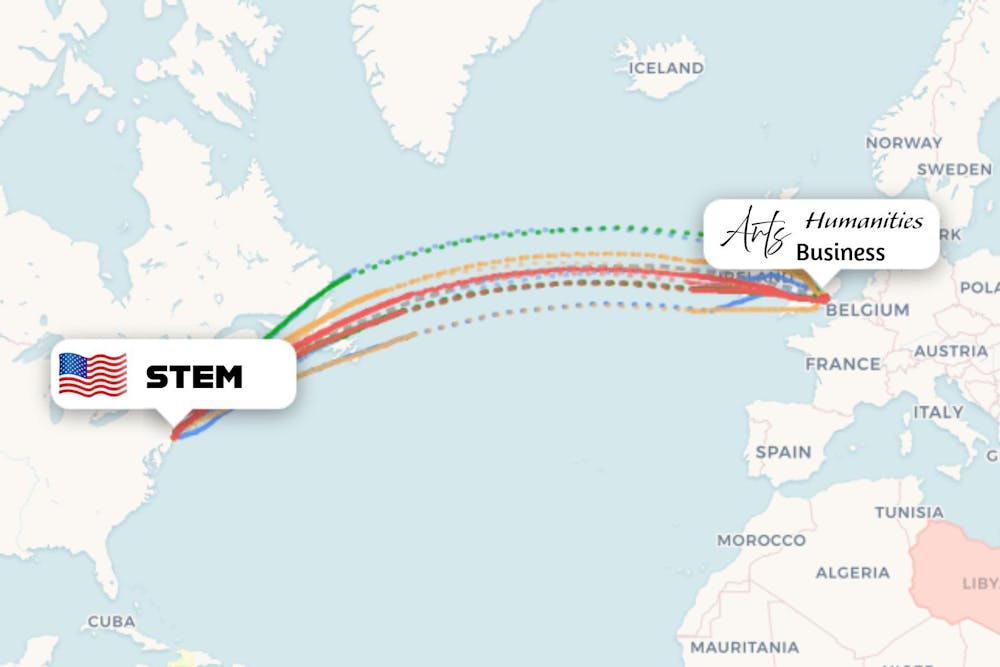
When Lara Victor arrived at Notre Dame from Taubaté, Brazil, she had a plan: international economics, a degree that combined her interests and made sense for the career she wanted. She found out it was the wrong plan, not from an adviser, but from another Brazilian student who had figured it out the hard way. International economics and economics look nearly identical on paper — the same field, two fewer classes — but only one carries a STEM designation, and that distinction determines whether a student can legally work in the United States for one year after graduation, or three. Victor switched.
“I felt basically forced,” she said. “There was no other reason.”
Optional Practical Training allows international students to work in the United States for 12 months after graduation. A STEM-designated degree extends that to three years, and with them come three chances at the H-1B lottery instead of one and access to employers who won’t invest in someone they might lose in a year. At elite recruiting levels, where a final round might have 20 equally qualified candidates, that distinction is critical.
“When you have that level of competition,” Roberto Pereira, a junior from Rio Grande do Norte, Brazil, said. “If I wasn’t at par with another applicant who had the three-year extension and I didn’t, I’m not sure I’d still have my job today.”
Pereira and Victor are both heading to McKinsey this summer. Both reshaped their academic paths around what the visa required. “It’s definitely a double-edged sword,” Roberto said. “I’m not sure which way I’d cut it.”
What makes this system function, to the extent that it does, is largely the students themselves. Both Pereira and Victor learned about OPT distinctions, not from advisors or orientation materials, but from Brazilian upperclassmen who had navigated the same maze a year or two before. When Victor brought the issue to her advisors, she found them caught off guard — surprised, she said, by the distinctions between what counts toward the designation and what doesn’t.
Tyler Grant, Notre Dame’s dedicated career adviser for international students, estimates that about half the students who understand the OPT landscape learned it from a peer. He has seen the consequences for the other half — students who arrived a semester behind on the information, who trusted the wrong source, or who didn’t have the right person in the right hallway at the right time.
“If you didn’t get on that train early enough,” he said. “There’s not really another stop.”
According to Grant, the majors that absorb the most OPT-driven enrollment are predictable: engineering, economics, ACMS and now finance, which received its STEM designation this past fall. That last shift is already reshaping departments. Victor said that economics professors are bracing for enrollment drops — international students who were double-majoring in economics solely for the visa designation will no longer need to.
For international students, the second major has rarely been a question of curiosity. It has been a calculation — which combination keeps the designation, which field is close enough to what they wanted and still checks the right federal box. American students double major in things that interest them. International students double major in things that protect them.
This is the quieter cost: Not that international students end up somewhere wrong, but that they are cut off from a version of college their American peers take for granted — the freedom to pair a professional major with something they chose purely because they want to.
Grant invokes “pressure makes diamonds,” and the cases exist. Pereira switched into business analytics reluctantly and found he liked it more than finance. But a system that occasionally generates growth through constraint is not, for that reason, a well-designed one. The student who was forced into a harder major and thrived is a real outcome. So is the student who spent four years in a discipline chosen not for curiosity but for a visa category — and who never found out what the alternative might have looked like.
Grant sees the starkest version of this in engineering. Aerospace students, for example, arrive as one of the most passionate group on campus — students who built things in their bedrooms as kids and came to Notre Dame because they wanted to work on rockets. Then they discover that aerospace, heavily tied to defense contracts, offers almost no straightforward path to employment for international students. They end up usually transferring to mechanical engineering. For some of them, according to Grant, it is purely a business decision, and they set aside the thing they loved to make it.
International students make up 10% of Notre Dame’s population. If Grant could change one thing, it would be to go department-by-department and ensure that faculty and advisors actually understand what their international students can and cannot do — which jobs they can apply for, which designations matter, which deadlines they are navigating that their American classmates are not. Grant said a global affairs professor once sent an international student a list of State Department openings. The student could not apply for any of them.
Ten percent of the student body is navigating this primarily by peer connections. That is the institutional failure underneath the individual stories.
Victor advises international students arriving at Notre Dame to “just get a STEM major. Don’t be all hopeful and dreamy. Just have a major you enjoy, and have a major that will give you a job and a visa. That’s what you need to do.”
As I write this piece, I would like to pause on that word — dreamy. Every international student at Notre Dame got here through an act of ambition that most people never attempt — crossing borders, learning languages, competing for a spot at one of the most selective universities in the country, while often carrying the weight of a family’s expectations alongside their own. International students are, by definition, dreamers of the most obstinate type. But the system they enter upon arrival is not built for innocent dreamers. It is built for students who already know, before their first semester, which majors carry which designations, which employers sponsor which visas and which hallways to walk down to find the upperclassman who will tell them what the adviser could not. The aerospace student who came to build rockets and left with a mechanical engineering degree did not stop dreaming. They just learned, quickly, what dreaming costs.
Maria Eduarda Grill is a sophomore from Maranhão, Brazil studying global affairs and economics with a minor in journalism, ethics and democracy. She writes reported opinion on the gap between what Notre Dame promises and what its students actually experience — which, it turns out, is a lot to write about. Tips, suggestions, and rebuttals welcome at mgrill@nd.edu.