The self-destructive death spiral of Ye, the artist formerly known as Kanye West, this past decade has been a horrifying spectacle. To see a man who once had the entire culture in a chokehold throw it all away for obsessive antisemitism has been like watching a Shakespearean tragedy. While Ye ostensibly cleaned up his act and mounted a comeback with 2024’s “Vultures 1” (a project I still quite enjoy, even though it pales in comparison to his best works), things quickly regressed thereafter. “Vultures 2” was a half-baked mess, and beginning in early 2025, Ye entered probably the worst manic episode of his career. Not only did he relapse into Nazism and all sorts of bigotry, but he also relentlessly insulted all of his family, friends and industry peers on Twitter. This second aspect made it much more difficult to watch than his late 2022 antisemitic stint: it felt like he was irrevocably destroying both his public and personal life.
His subsequent 2025 musical output truly left me speechless: An anthem praising Adolf Hitler, a startlingly vulnerable song detailing a past incestuous relationship with his cousin, an unreleased album titled “Cuck” and Dave Blunts of all artists becoming his musical muse. A celebrity of his stature, tearing himself down and sinking to the absolute abyss, almost felt like performance art, but the pain and hate on display was uncomfortably real. Ye then went quiet for a few months, but has now reemerged for the release of a new album, “Bully,” which had been teased on and off since late 2024. In January, he took out a full-page advertisement in the Wall Street Journal containing an open letter titled “To Those I’ve Hurt,” in which he apologized for his past antisemitic rhetoric and attributed it to neurological damage caused by his infamous 2002 car accident. Accompanying this apology was his signing to Gamma, a new music label founded by Larry Jackson that would handle the release of “Bully” in March. I find it fascinating how eager people are to rehabilitate Ye after his public meltdowns time and time again; it’s a testament to an artistry that is irresistible beneath all the noise.
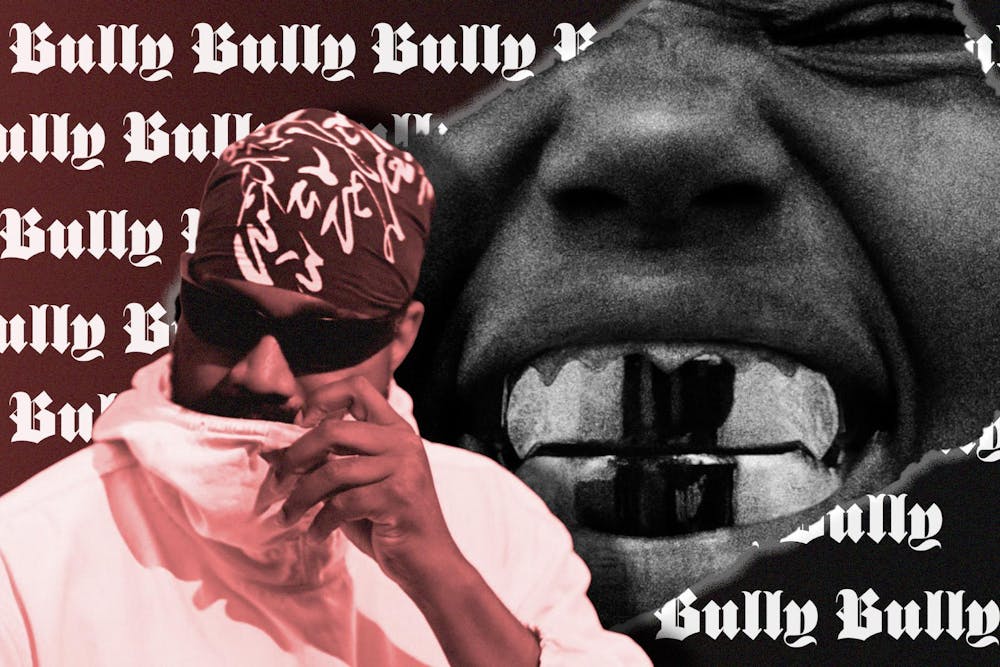
After a few delays and last-minute additions in classic Kanye fashion, “Bully” was released to streaming services Saturday. Now, my expectations for this album were very, very low. Ye had developed a nitrous oxide addiction in 2025, so I was genuinely unsure if his cognitive abilities were still intact. Furthermore, all the snippets I heard sounded like most music he had released since “Vultures 1”: unfinished and riddled with artificial intelligence. But as I listened to the album opener “King,” my skepticism faded away. Ye returning to industrial hip hop again? Hard-hitting production with a fuzzy bassline and clanging drums? Are we back?
“Bully” exhibits Ye’s peerless intuition for melody and production. The beats are richly textured and well crafted, reminding you why he’s such a singular talent behind the boards. Industrial influence is heavy throughout “Bully”: the vicious drums of “Father” and the buzzy 808s of “This a Must” lend the album an aggressive quality. Yet, we also see Ye skillfully return to his chipmunk soul roots with songs like “Punch Drunk” and “Whatever Works.” Ye also developed a deep love for vocoders when making this album, employing them on the plaintive “White Lines” and “Mama’s Favorite,” as well as “All the Love,” the shining jewel of the album. The song’s propulsive kick drums and glistening melody make it soar.
While “All the Love” is a euphoric anthem, the album’s mood is otherwise gloomy. Haunted synths creep up on “Sisters and Brothers;” “Damn” has Ye reflecting on self-destructive behavior over a minimal bass line; the title track’s patchwork sampling gives way to a menacing chorus from CeeLo Green. The album teeters between somber introspection and braggadocio looking to reclaim dignity lost. This ties together the disparate industrial, soul samples and synth sounds into a cohesive statement of a man trying to build back his world.
In fact, this might be the Ye album that demands to be listened to as a cohesive unit front to back more than any other, and that’s because the songs are short — very short. Many songs on this album don’t even pass the two-minute mark. While I would have liked to see these songs have more musical progression, their leanness grew on me the more I listened. The songs never overstay their welcome, and they flow between one another very smoothly, making the album addictingly easy to listen to.
The big problem holding this album back from being really great is Ye's rapping and lyricism. He often sounds devoid of passion; the contrast is especially obvious on “Father” when Travis Scott comes swinging in after Ye’s lethargic delivery. Moreover, most of Ye's lyrics are generic and nondescript. I understand if he’s not super eager to talk about the past year, but I would have liked a little more specificity. He comes off as a cypher on the album; beneath the forgettable one-liners, it’s hard to gauge where the man’s head is currently at. The soundscapes reveal much more than his actual words — a retreat into the past haunted by the turmoil of the present.
“Bully” reminds us why it’s so difficult to fully quit Ye. His inventive production and melodic sensibilities are always a treat to listen to, and the album is consistently engaging, even in the more sparse back half, which has proved divisive. But I’m not sure if he was quite ready to return to the world. He says very little of substance over the 42-minute runtime, lacking the verve and wit of his best work. So while “Bully” is a good album, it’s still a far cry from his earlier albums that had boundless ambition and real vulnerability.