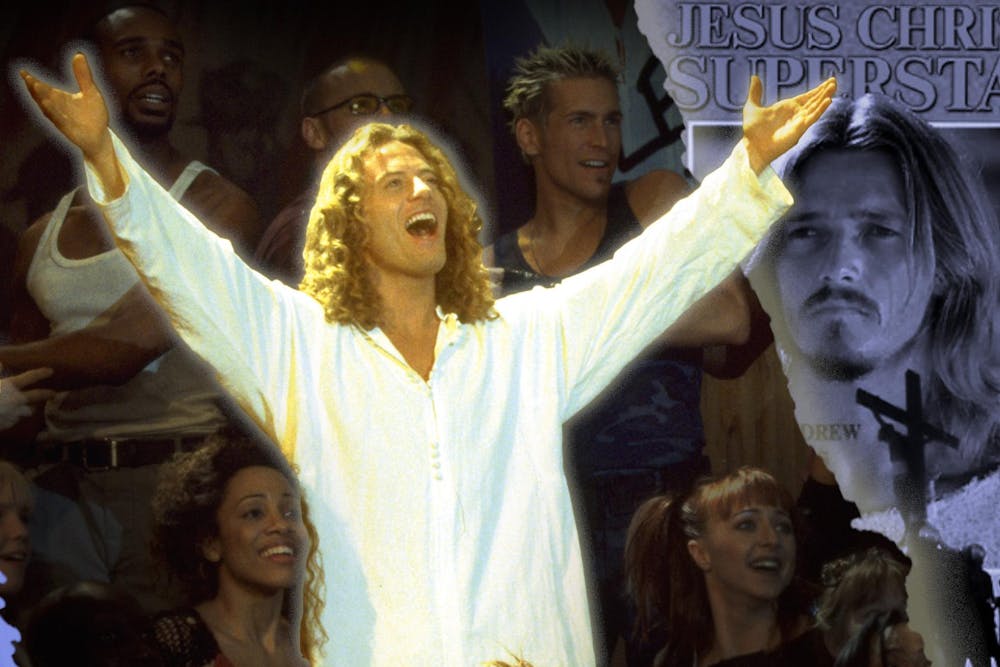
Holy Week, the pinnacle of the Catholic calendar, is here, and with Easter nearing comes an increased engagement with Andrew Lloyd Webber’s “Jesus Christ Superstar,” a rock opera loosely based on Jesus’ life told from Judas’ perspective. Admittedly, while loving its music and vibe, I take issue with its presentation of Christian doctrine. “Superstar” is secular media and not a Christian work; yet, for many, it was their introduction to Christianity and led to conversion. It’s not meant to be taken seriously theologically, but with the Triduum providing opportunities for reflection on Christ’s Paschal Mystery, I want to examine how to “redeem” “Superstar” in a way that aligns with legitimate Catholic teaching while still maintaining its rocking identity. This article will primarily critique the show’s theology as presented in the music, and my solutions will mostly be musical changes and minimal blocking notes. Many know “Superstar” through the 1973 film, but I won’t consider it in this analysis. The film is pure camp and not serious at all, though it’s still a fun watch.
The show’s theological questionability makes sense when examining the religious beliefs of its writers. Tim Rice, lyricist, is a self-proclaimed agnostic, claiming he was raised in the Church of England but doesn’t identify as Christian. Similar sentiments apply to Lloyd Webber. The duo approached the musical not from a religious stance but from a non-dogmatic one.
My greatest issue with “Superstar” is the ambiguity of Christ’s divinity. He is portrayed as a misunderstood human — not God — unclear of His role. Christianity understands that Jesus knew He was the Son of God. Jesus has a true human will, but it’s perfectly aligned with the divine will. He was aware of the events to come and the Father’s master plan. The title track addresses this uncertainty of Christ, stating: “Jesus Christ / Superstar / Do you think you’re what they say you are?” Jesus, in reality, never once doubted His divinity, and the opinions of others wouldn’t have swayed Him.
The Catechism states “that Jesus Christ is Son of God by nature and not by adoption,” (CCC 465), but His portrayal in “Superstar” suggests otherwise. Adoptionism, a heresy, posits that Jesus wasn’t inherently the Son of God at birth but was “adopted” into the role. Catholicism teaches that Jesus is fully God and fully human, perfectly having both natures. The lyrics in “Gethsemane” mostly propose an adoptionist view. For example, “Why then am I scared to finish what I started / What you started, I didn’t start it.” These lyrics do not reflect Jesus’ fully divine nature, instead making it appear as if God selected Him for the role of redeemer without providing adequate background. As established, Jesus was completely aware of what He had to do. I don’t have many re-write suggestions for “Gethsemane” rather than a complete lyric overhaul. Instead, I warn listeners to be wary of the song’s heresies and challenge them to discern these moments with a critical ear.
Most mainstream musicals include a romantic subplot; they sell and please audiences. In “Superstar,” it’s heavily implied that Mary Magdalene and Christ are involved romantically. There is nowhere in the canonical Gospels that suggests a marital relationship between them. In fact, this is a relatively modern interpretation. It would be easiest to just remove all indications of this relationship and rewrite Magdalene’s lines, making it explicit that the relationship between her and Christ is purely friendly.
In “The Crucifixion,” Jesus asks for His mother. While this is not inherently wrong, it could’ve been a great moment to add an extra set of lyrics highlighting the institution of Mary as Mother of all believers. In my re-write, I would add Jesus singing: “Mother, behold your Son! / Son, behold your Mother!” (adapted from Jn 19:26-27). In the stage direction, John escorts Mary off-stage, indicating that he takes her into his home. Not all changes have to be dramatic; these simple words add weight and theological substance.
Another noticeable omitted interaction is with the penitent thief. As wonderful as it would be to give the thief his own song, to keep the pacing and intensity of the show, I would add his encounter with Jesus into “The Crucifixion.” The lyrics would be pulled from Luke’s Gospel, in which the thief, from his cross, says: “This man has done nothing wrong. Jesus, remember me when you come into your kingdom.” Jesus replies: “Amen! Amen! I say to you: Today, you will be with me in paradise!”
Notably, “Superstar” omits the most important part of the Paschal Mystery, Christ’s Resurrection, instead ending with the instrumental “John Nineteen Forty-One” where Jesus is removed from the cross and carried off-stage. There is no indication that this isn’t the end of Jesus’ story, which makes His death appear definitive. My fix for including the Resurrection is fairly simple. One could include it without an additional scene or explicitly going “He is Risen!” At the end of “John Nineteen Forty-One,” add the “Superstar” main motif right before bows with a slightly triumphant touch. For this to truly read as a Resurrection moment, I would accompany it with bright lights or a sunrise. Another fix could be to have a tomb prop on stage. When the show ends, the door is closed, but it’s open during bows, implying the Resurrection. This would be most potent if paired with the aforementioned “Superstar” as a Resurrection musical motif.
Some argue “Superstar” is a modern interpretation of the ancient practice of passion plays and point out that the Stations of the Cross end with Christ’s burial (Station 14), not the Resurrection. “Superstar” aims to paint a broad picture of Christ’s life, not focusing solely on the Passion. The scope and aim of the musical is not to be a meditation on Christ’s death, but rather to examine his final days on a larger scale. Stations are a meditation solely on Christ’s suffering; they don’t claim to be a full portrayal of the Gospel and assume a belief in the Resurrection. Even so, in 1991, Pope John Paul II released the “Scriptural Stations of the Cross,” which includes a Resurrection reflection. So, “Superstar’s” lack of the Resurrection is an intentional omission to keep Christ’s identity as the Son of God vague; it does not make a claim about His divinity.
“Jesus Christ Superstar” is a fun musical, but it has terrible theology; however, it’s not too far gone to be corrected to be both rocking and doctrinally accurate. I would advise not taking it seriously; accept it for the rock album it is and don’t accept any of its faulty teachings.