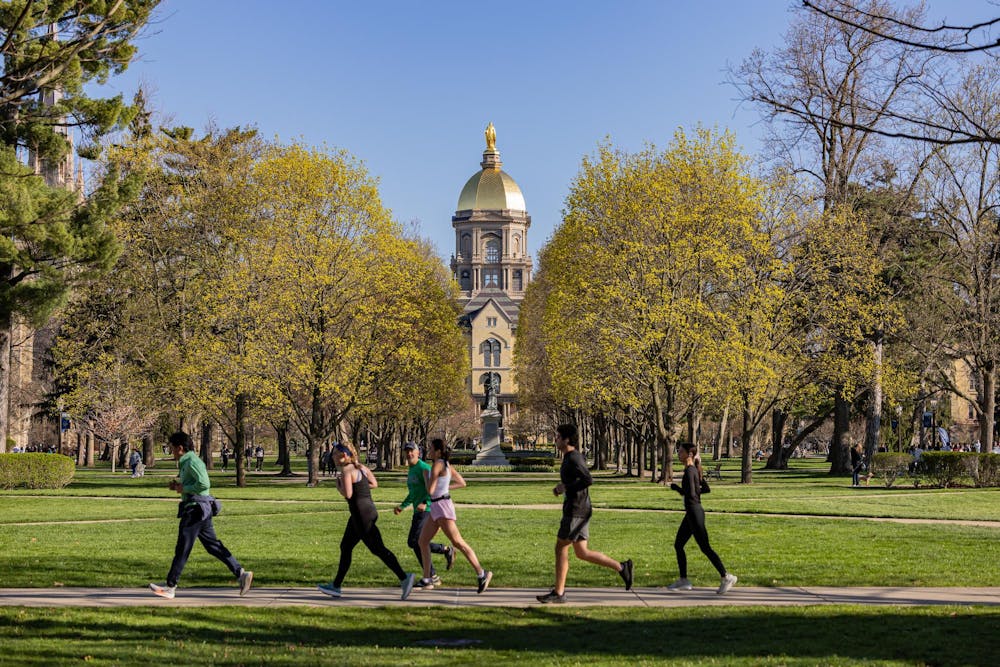
Despite some technical difficulties in its planning phase, and a 37-degree Fahrenheit temperature at the horn, the Holy Half kicked off 7:50 a.m. Saturday without any major setbacks.
Racers could choose between two heats: one for an average mile time faster than eight minutes, and the other heat for slower averages.
Runners were initially informed that the slower heat would begin 10 minutes after the first, but only five minutes later, the signal rang for heat two to begin.
Water stations and resources for the runners were spread throughout the route. Outside of Keenan and Stanford Halls, a group of students blasted pop music. Farther along the route, the Notre Dame Bagpipe band serenaded runners.
A station near the Grotto included a medical team, and additional medical personnel were available in a curtained-off section of Stepan Center. Other members of the medical team circulated the route on bicycles and the South Bend Fire Department was on site at Stepan Center.
Girls on the Run Michiana, one of the beneficiaries of the Holy Half, provided an inflatable finish line arch. The arch faced some gravitational challenges, but with frequent readjusting from volunteers, it survived until the end of the race.
Einstein Bagels, bananas, protein shakes, water, and medals welcomed runners at the finish line.
Aaliah Magee took first in the 10k with a chip time of 34:31.2, followed up by Thomas Swartz with a chip time of 40:33.5.
Cade Czarnecki won the men’s half-marathon with a chip time of 1:16:30.3, followed by Brady Ballou with a time of 1:16:37.0 and Jack Whitman with a time of 1:17:05.5.
For the women, Olivia Dietzel won with a chip time of 1:16:57.5, followed by Colleen Lucey with a time of 1:25:12.5 and Lexi Allen with a time of 1:25:54.1. Dietzel was previously the overall winner for women in 2024 as well.
The community showed out with a variety of creative signs. Several signs read, “On a scale of 1-10, you’re a… 13.1.”
Others took jabs at recent politics writing, “You run better than the government,” and “Due to inflation, you'll be running 16.7 miles.”
Thomas Kerber, a junior in Keenan Hall who ran the half-marathon, said, “The run went well. It was a good course, just two loops through. Could have been marked a little bit better. I was near the front group and some of us were getting a little bit lost, but it was a lot of fun.”
Jim Mumaw, a South Bend local who ran the 10k for Girls on the Run, said, “It is a great way to see campus. You get to run out by the lakes, and then you get to go to the quads and the finish with the sun hitting Hesburgh Library and Touchdown Jesus, you are almost to the finish line, so it is a great way to end on a beautiful day.”
He later noted that he “took a minor detour,” thereby extending his route, but said this was fun because he got to see a little more of campus.
Leading up to the race, runners were able to pick up bibs, shirts, safety pins, candy and stickers at check-in from 10 a.m. to 4 p.m. on Friday. Alternatively, runners could pick up their packet Saturday morning ahead of the race, beginning as early as 6 a.m.
A total of 1635 bibs were passed out.
Cecilia Pino, co-president of the Holy Half Marathon, declined to comment on whether people had gotten off the waitlist, which was once over 800 people long.
Those who attended between 11 a.m. and 3 p.m. on Friday had the chance to receive an individual sports biomechanical assessment from Notre Dame Sports Biomechanics Research Group.
Craig Goehler, a teaching professor in mechanical and aerospace engineering and director of the predominantly undergraduate-led Sports Biomechanics Research group, spoke with the Observer about the assessments.
The group uses a motion capture suit to provide feedback on bilateral symmetry and joint torque, Goehler said. However, in their on-demand clinic, they are able to do "motor preference analysis” to look at neurological preference and predisposition within the body. Goehler explained that this is similar to how people have a preference for being right-handed or left-handed.
“We are not coaching anybody,” he said. “We are not training to telling them what to do. We are just giving them more information, so they have a better understanding of what they are doing and then they can go out and figure out what they need to do.”