It feels like everywhere I turn, companies are attempting to implement new AI features — to varied success. I see ads daily for AI summaries, notetakers and chatbots that can supposedly “optimize your workflow” and “boost your creativity.” Of course, these tools are only as good as the data they are trained off of — data that is largely provided, willingly or not, by humans. In an age where human thinking is constantly being outsourced to algorithms, what might a human-powered and human-controlled large language model look like?
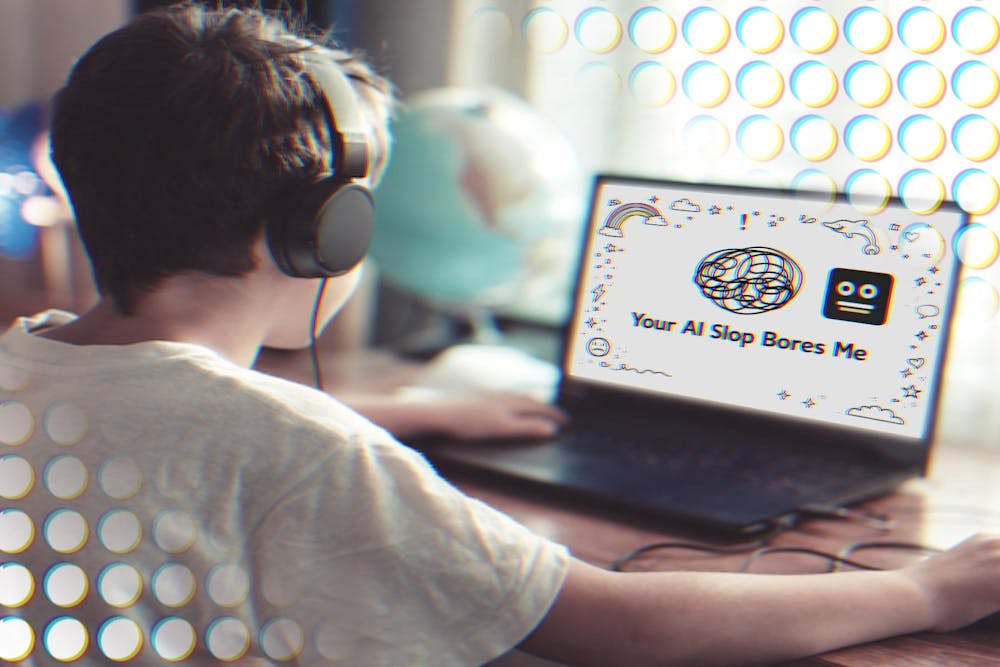
The answer, as I’ve come to find out, might lie in “Your AI Slop Bores Me”, an online web game where humans role-play as either a person giving prompts to a chatbot, or as the chatbot itself. Created by programmer Mihir Maroju — who was inspired by what he called “a frustration for AI art and its proliferation” — the game is simple: A human submits a prompt, and an “AI” player receives and responds to it.
To keep the number of humans and “AIs” balanced, each prompt costs one virtual credit, and players earn credits by answering prompts as “AI.” When playing as “AI,” players are placed in a queue where they wait for an available prompt. Once a player receives a prompt, they can then respond with text or a drawing, provided they complete it within a minute — unless the human turns on “thinking mode,” which doubles the allotted response time at the cost of two credits.
The prompts and responses you receive vary greatly in quality. No human is going to know the exact answer to every question they are asked. I sometimes receive in-game prompts with a quote I don’t recognize or a character I’m supposed to draw from a piece of media I’ve never heard of. Luckily, you can skip prompts you can’t answer, and it is then passed on to another player.
I can’t fault the people sending prompts for trying to find someone else who could share their interests. I believe the best kinds of prompts to send “AIs” are general questions that depend on personal opinion, such as book or film recommendations; people generally like talking about what they like. It can be fun to catch a glimpse of someone’s personal tastes or share my own if I’m on the receiving end. I once received a prompt to draw my favorite album cover, and while my end result looked messy, I was still pleased with it.
As enjoyable as this social experiment is, it only works if its participants are willing to abide by the rules of the game. To keep everything running smoothly, users can vote on whether or not a response is helpful by giving it a thumbs-up or thumbs-down rating. Users with more thumbs-up ratings are rewarded with a shortened wait time to receive a prompt, while users with more thumbs-down ratings must wait longer. There is also a built-in report system so users can report spam, external links and other prompts or responses that break the site’s code of conduct. While these preventative measures seem to be working well, at least from what I’ve seen, it can still be disheartening to receive negative responses. As I mentioned before, when you play this game, you are signing up for variety, whether good or bad.
Above all, “Your AI Slop Bores Me” gave me a new appreciation for the human aspect of writing and art. I could ask an AI image generation model for an image of a pie, but no matter how “good” it looks, the image is soulless to me. While AI could have logistical knowledge about what a pie should look like, there is no way for it to know how it feels or tastes. That knowledge can only come from experience, which is why I would prefer to go to this game and receive a drawing of a pie created by a human with one minute, a computer mouse and a vision. I get satisfaction from knowing that someone somewhere on the planet spent time and effort drawing that pie.
It can be quite fun to shove off worries of AI stealing one’s job by stealing AI’s job right back. Though it doesn’t make much of a global impact in the grand scheme of things, it does make an appealing statement about human ingenuity and taking back creative control.