
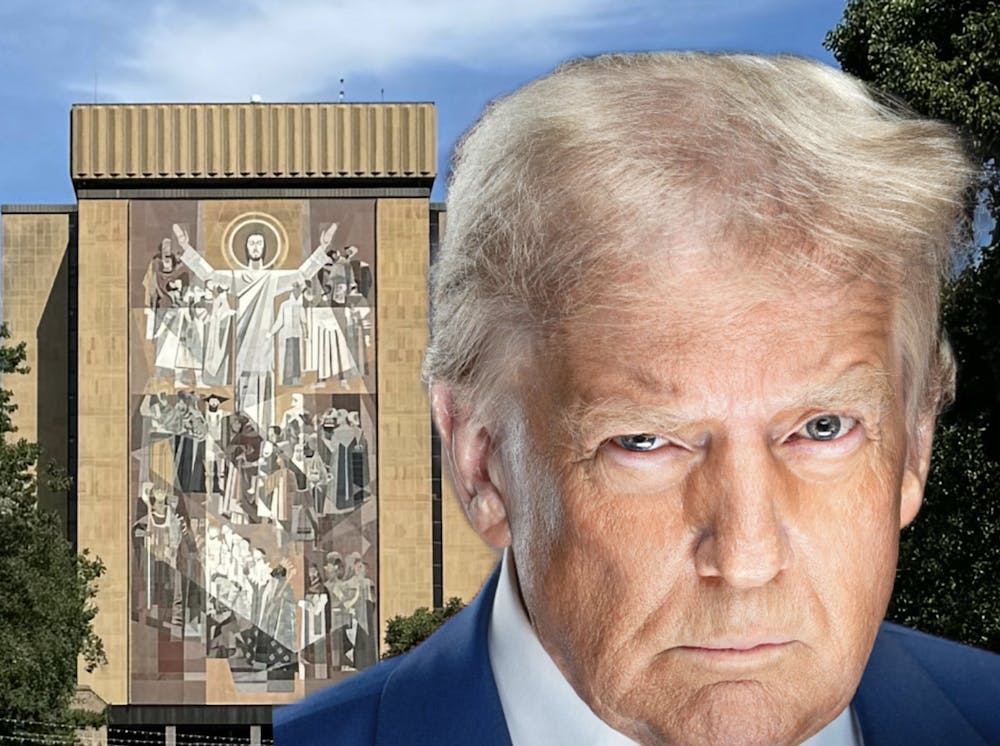
Last week, The Observer’s own Jonah Tran published an extremely helpful how-to guide on the proper method of writing a boring Opinion article. In a stroke of pedagogical genius, Tran encourages Observer Opinion columnists to maximize their boringness by writing about politics, using buzzwords like “fascism” and citing sources. As I pondered the subject of my column today, I initially drafted an effectively boring article about congressional redistricting (using Tran’s guide as my roadmap, of course).
However, as I drafted my eloquent and well-informed article (with so many sources), I began to ask myself: Why am I doing this? Does anyone actually want to read my (very) boring political article?
I then entered the proverbial descent into the dark, questioning the purpose of my column. Such soul-searching was unbecoming for what was supposed to be a quiet weekend. I began to falter in my resolve, believing that perhaps my boring political writing was more of a blight than boon on the once-proud Observer. While in my state of mental anguish, I stumbled upon the Sept. 24 issue of The Observer, open to Thomas Murphy’s “Response to College Republicans.” Only then did I realize that maybe our student newspaper actually benefits from boring political articles.
Satire like Tran’s can be important in our Notre Dame discourse; it keeps us humble, as any good satire does. However, the author’s clear disdain for political Opinion columns seems to short sell the immense value of political dialogue on campus.
In the wake of right-wing activist Charlie Kirk’s assassination, The Observer was flooded with Opinion pieces mourning his death, discussing his assassination’s implications on free speech and criticizing his legacy, among other topics. Both the editorial board and columnists of the paper contributed insightful, critical and well-informed pieces on what will likely prove to be a watershed moment in the history of American political discourse.
Notably, Shri Thakur’s letter to the editor suggests that far-left voices “should be purged from institutions and socially ostracized” in the wake of Kirk’s death. He offers an endorsement to the return of McCarthyism, as, in his words, “History proves that resolute steps are necessary when ideologies threaten the very fabric of a free society, and we must heed its lessons now.” Thakur’s claim that the “modern left” “threatens the very fabric of a free society” certainly proved to be a conversation starter in my social circle and was among the most-read pieces in The Observer for the week. While his article is deeply offensive and betrays the most fundamental American values of free expression, I believe that it is actually worthy of some praise: It contributed to an active conversation regarding campus politics. Thomas Murphy’s aforementioned response to Thakur continued that conversation, fostering dialogue between disagreeing voices.
What’s more American than that?
The health of America’s political institutions is entirely dependent on the continued civic virtue of its citizenry, in their zeal for political and civic engagement. Much ink has been spilled concluding that there is a direct correlation between the institutional stability of democracies and the civic engagement of its people, however, a more convincing example is one that I am sure everyone has witnessed. I therefore pose the question: When having a political conversation with another person, is the conversation more productive when that person is well-informed?
Political discourse on campus, especially in its most consistently circulated publication, remains particularly necessary and valuable. Here at a residential campus like Notre Dame, students remain exceptionally self-contained. One rarely leaves campus, and if he or she does, it is usually not beyond South Bend city limits. We, quite literally, live in a bubble. With the multitudes of demands on our time, it can be difficult to remain well-informed on the many happenings in the outside world. Political Opinion articles like those concerned with free speech, the death of Kirk and criticisms of the Trump administration are essential in the formation of a well-informed and ideologically sound citizen. They are accessible; if a tri-campus student does not engage with The Observer, it is entirely by choice. College, in many ways, is a training ground for the “real world.” Why would we want to shy away from participating in an essential form of adulthood like civic engagement?
If you’ve made it this far, you perhaps have realized that this article is not actually about Donald Trump, the Democratic party or anything else that a critical Observer reader might identify as “boring.” But even if it was, you’d probably be better for reading it. While it’s important not to take ourselves as amateur columnists too seriously, perhaps we should reflect on the ongoing debates within our paper’s pages. What we’re seeing with the free speech debate is but one example of an important function of our student newspaper. Let me conclude with a cliche call to action, as any good boring Opinion article would: Give the political discourse a chance. Our laboratory of democracy needs peer-review.
Grayson Beckham is a freshman living in the Coyle Community in Zahm Hall. He hails from Independence, Ky. When he's not publishing woke propaganda inThe Observer, he studies political science and eloquently uses his silver tongue on the mock trial team. You can send him relevant hate mail at gbeckham@nd.edu.


