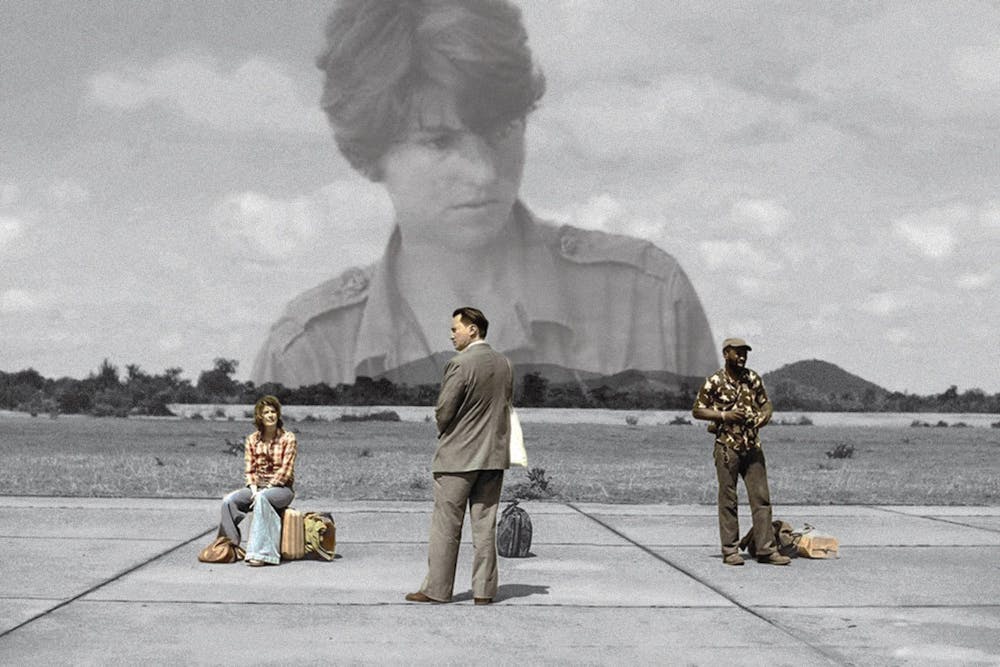
Last Sunday, I walked over to the DeBartolo Performing Arts Center to watch the film “Meeting with Pol Pot.” The movie was introduced by professor Ray Offenheiser and prefaced with a speech by the author Elizabeth Becker, who was portrayed by actress Irène Jacob in the movie. The film begins with three journalists in Cambodia, invited by Khmer Rouge leader Pol Pot to tour the country. Slowly, they realize the horrors and atrocities committed by the Khmer Rouge.
I did not enjoy the movie. The performers were unremarkable. The characters’ reactions to the atrocities didn’t seem real or carry much depth. While one might say this is entirely the fault of the actors, their performances were not at all cushioned or elevated by a well-written script. In defense, one might say the background of individual complexity was intentionally discarded so the movie could focus on the horrors of the external world that was Cambodia under the Khmer Rouge, but even given this opportunity, they don’t take it — we spend most of the movie watching the characters’ slow acknowledgment of the horror. But the average watcher, even if he doesn’t have a cursory conception of Pol Pot’s Cambodia, is able to guess at the magnitude. The movie spends all this time building up to several emotional revelations where the viewer can guess the emotional revelations about two minutes into the movie.
The portrayal of the first flurry of dramatic moments, where the viewer is first alerted that the country is in disarray and people are suffering, was diluted by the director’s clumsy “creative” cinematography. He portrayed the evils committed by the Khmer Rouge with static wooden carvings. The director switched out what was intended to be the dramatic height of the movie with frames that were supposed to be a symbol for its significance. Never will merely pointing to a symbol of a distressing scene actually leave the audience with the same impact as the actual distressing scene. The director had budgetary constraints, and he solved it by avoiding any confrontation with the primary subject of the movie — a poor move.
The second climax, where the interviewers finally meet and talk to Pol Pot or “Brother Number One,” is similarly disappointing. Pol Pot has his face concealed (a lazily enacted cliche) while he justifies to the interviewer, an educated Marxist, why he committed the atrocities. Pol Pot is given zero nuance in his justifications and is portrayed as a cartoonish supervillain. And perhaps the director ethically doesn’t need to portray Pol Pot as having nuanced justification for the massacres, or perhaps he doesn’t because Pol Pot realistically had none — either way, the discussion was uninteresting, and I think uninteresting is a decent encapsulation of the entire film.