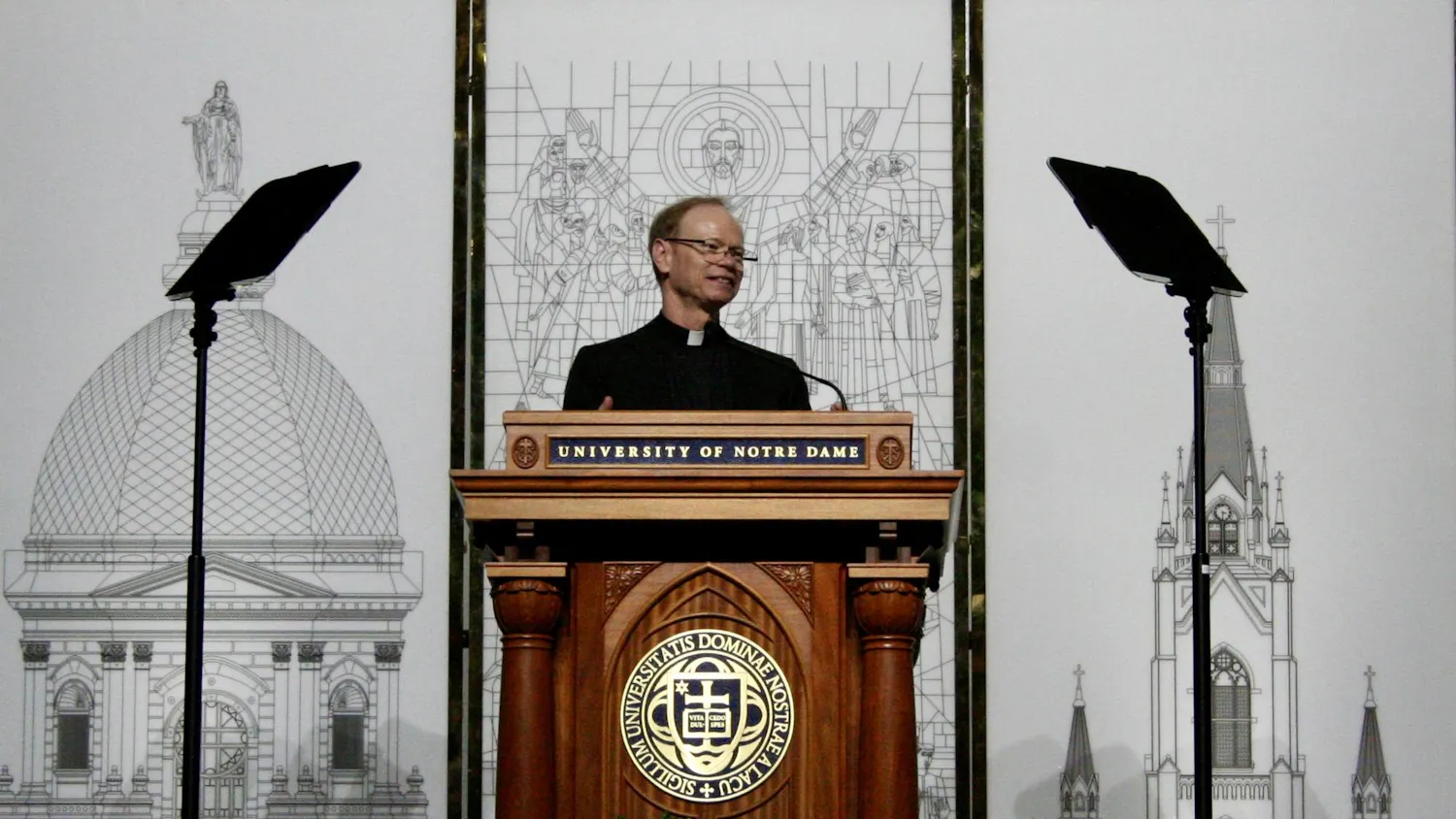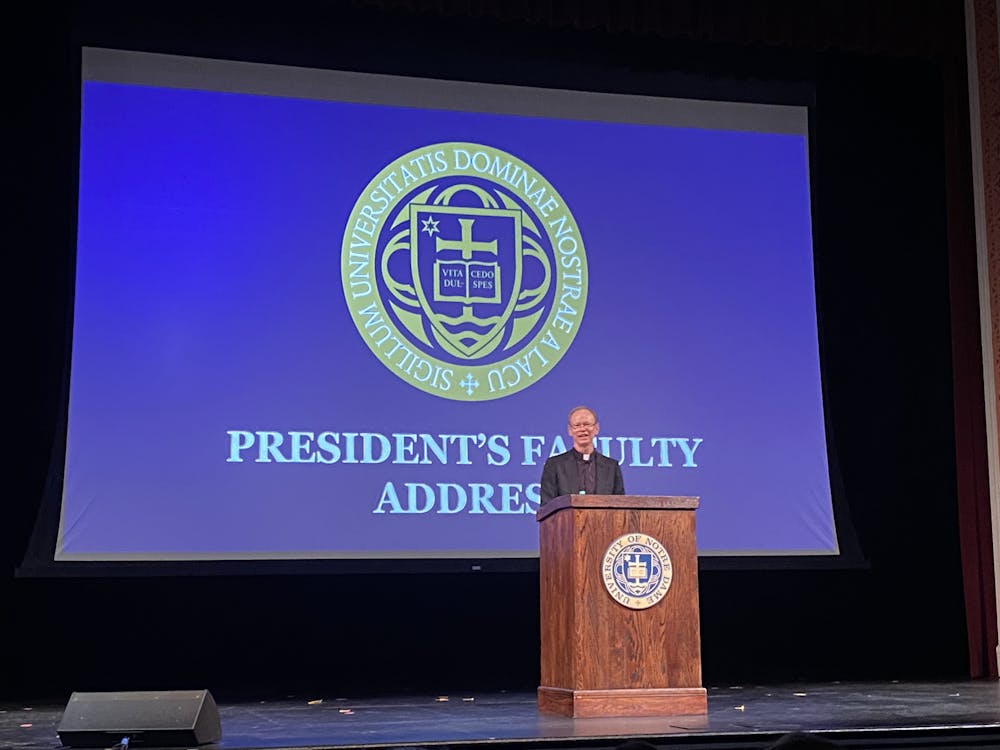
On Thursday at 4 p.m., Notre Dame President Fr. Robert Dowd addressed faculty and academic staff members in the president’s faculty address inside Washington Hall. The University also hosted staff town halls on Wednesday and Thursday of last week.
Dowd began his remarks by thanking those present for their work and for attending the address. He quickly began discussing the “pace and degree of disruption in higher education,” including the increase in the endowment tax, reductions in research grants and financial aid, and “the dismantling of DEI programs.”
Dowd called this “an important inflection point in higher education in the United States.”
Quoting the late Pope Francis, he said, “We are living in not just in an era of change, but in a change of era.”
However, amid the changes, Dowd told the faculty of his pride and gratitude for their work during a difficult time, when the University has “implemented a staff hiring freeze, a 2.5% budget reduction and paused new construction.”
In this moment, Dowd said that the University’s Catholic mission helps the institution to continue on its path despite the worldwide setbacks.
“It anchors us in times of disruption and it opens us. It opens to new ideas and it opens us to one another in the pursuit of truth,” Dowd said.
He then discussed having met with faculty members over lunches, which he said he found inspiring. He also invited faculty members to contact him and said he would respond to all communications from them.
Dowd then discussed three areas of the University where he believes that they have made progress in and still have work to do: research and scholarship, teaching and learning and how Notre Dame is building community.
Beginning with research and scholarship, Dowd explained that “for many, many years, we have worked hard to become a stronger research institution. Our faculty’s achievements, your achievements, have earned us not merely recognition, such as membership in the AAU [Association of American Universities], but the responsibility to embrace our distinctiveness.”
Pursuant to the strategic framework, Dowd said that the University hopes to continue the plans for each individual school and continue to attract academic leaders. He discussed how in the past four years, there have been 40 senior faculty hires as well as new junior faculty members. Dowd also stated that there are postdoctoral students who have come to Notre Dame, in addition to the graduate students, for whom they have done several things, “from increased stipends to extending health insurance to our doctoral students’ spouses and dependents.”
Dowd hopes to continue to increase innovation despite the many sacrifices. He shared that he has continued to advocate on behalf of Notre Dame with other institutions, including the AAU, on the national level.
He hopes “to offer unsurpassed undergraduate education … that is truly holistic, that integrates both the life of the mind and matters of the heart.” To this end, Dowd has worked to reimagine the Moreau First-Year Seminar.
Dowd highlighted the new Student Research at Notre Dame (STRAND) undergraduate research program, as well as the new four-year advising program as ways the University is seeking to help undergraduate students.
Dowd also discussed AI and the new classes that are taking place relating to it. Each student and faculty member is eligible to take an online, introductory course on AI.
Last year, Dowd founded the Pathways to Notre Dame program, which he shared was made possible through a large fundraising campaign, that has helped to expand financial aid and make Notre Dame both more accessible and affordable.
In the first year, the program has “increased students from middle-income families by 3%” following a decrease of 6% over the past several years. The program shifted the University towards a loan-free financial aid model, which Dowd mentioned has made it possible for these families to afford attending Notre Dame. He also stated that this year’s class has also become more globally diverse.
Dowd said he hopes to create a greater sense of belonging and community within the Notre Dame community by having students who become “the bridge-builders our country and our world need.” He called the Notre Dame community a place where students can continue to have respectful debate, which he is proud of. He cited the Israel-Palestine Series of academic talks and the Democracy Initiative’s ‘Disagreeing Better’ talk with Utah governor Spencer Cox and New Mexico governor Michelle Lujan-Grisham, which he said demonstrates the civil dialogue and debate of Notre Dame across all borders.
In addition to the general faculty address, Dowd expressed similar themes in one of his staff town halls at 1 p.m. on Thursday.
Beginning his speech, he thanked everyone present for their work around campus, especially during what is the busiest time of year for tourists due to football season.
Dowd discussed several updates to the staff at Notre Dame. Brandon Roach, former executive associate general counsel, has been appointed the new vice president and Robert K. Johnson has served as general counsel for the University since June.
Dowd also asked for every person to speak up if they witness misconduct at Notre Dame. As part of the University’s Catholic mission, Dowd emphasized that every person is a child of God and that he believes Notre Dame’s job is to ensure that everyone feels welcome.
Following Dowd’s speech, Provost John McGreevy spoke about the 2033 Strategic Framework plan for Notre Dame. He mentioned that the goal of this plan is to create “the best possible Notre Dame” and highlighted the hiring of recent new deans in a number of colleges within the University. Similar to Dowd during his faculty address, McGreevy also discussed the new Moreau course and the four-year advising plan, which he hopes will lead to a better future for Notre Dame.
To conclude the event, University executive vice president Shannon Cullinan spoke about the new physical changes to the University, such as the creation of Coyle and Therese Mary Grojean Halls, where Fisher and Pangborn Halls used to be, as well as the South Dining Hall renovations. The University is also working with a development partner in the construction of Colfax Corner in downtown South Bend, which will be occupied partially by the University and partially leased by private companies.