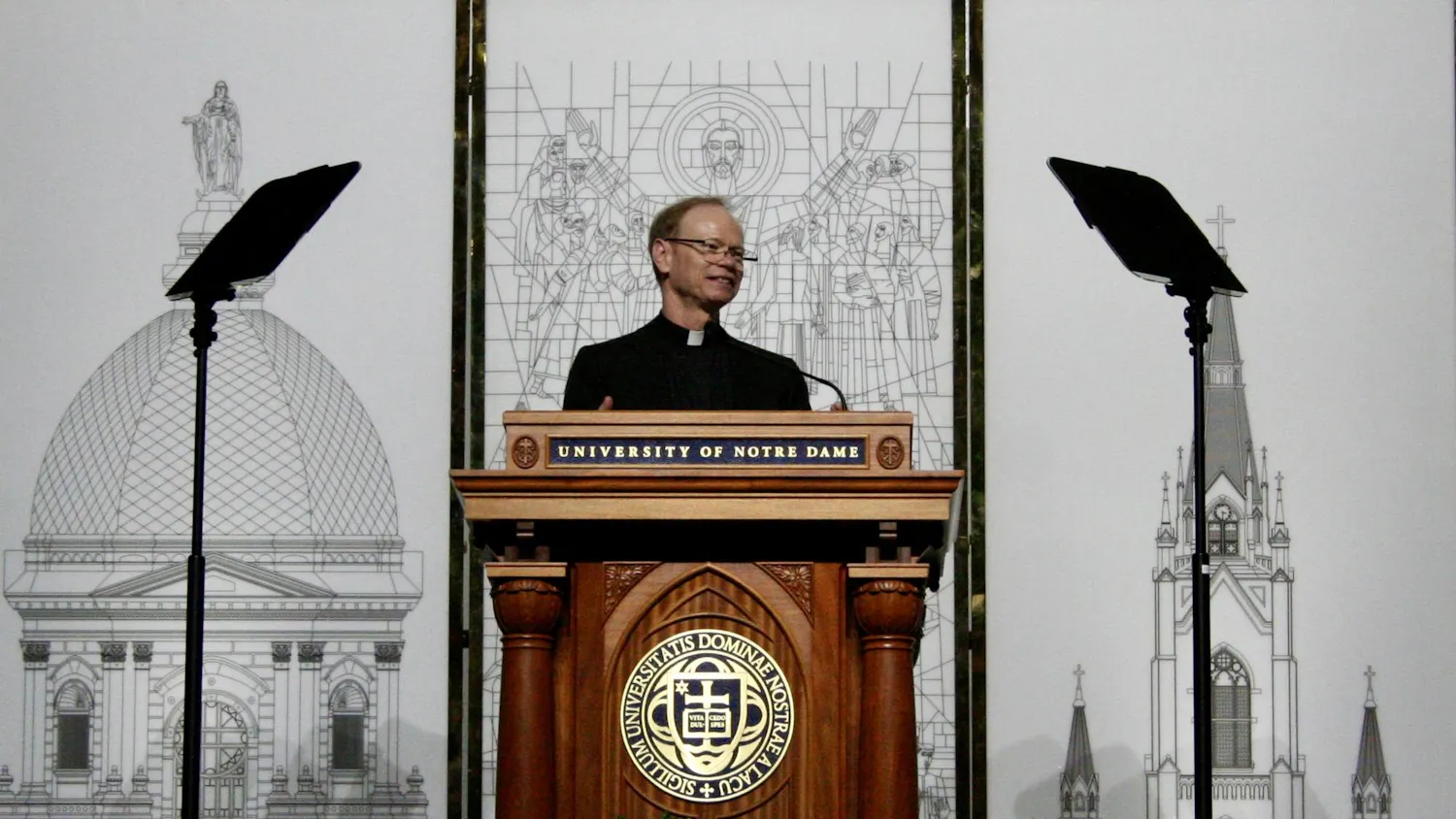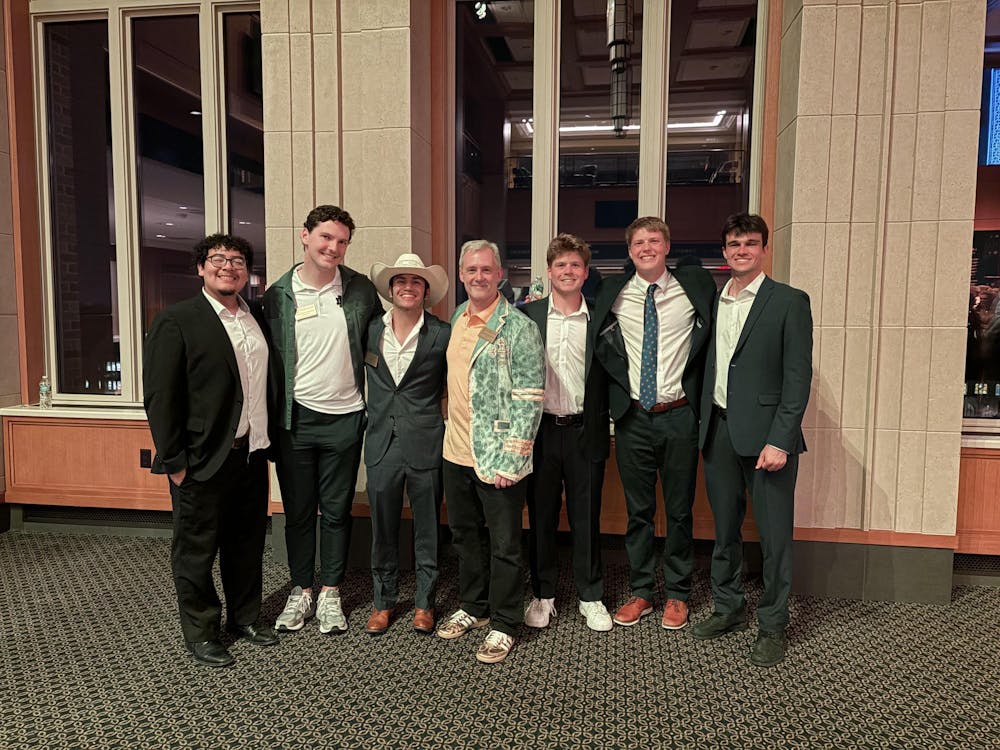
David Diamond is not an ordinary rector. Now in charge of Morrissey Manor, Diamond is a military veteran and assisted 20 victims during the Boston Marathon bombing.
Military career
For Diamond, the path to becoming rector of Morrissey Hall was anything but conventional. A retired U.S. Army colonel who spent decades in Special Forces, Diamond now leads one of Notre Dame’s residential communities — a role he sees as a continuation of a life defined by mentorship and service.
After retiring from the military in 2025, Diamond enrolled at Notre Dame to pursue a master’s degree in theology, which he has since completed.
Looking back, he sees the transition as part of a larger calling. “The Lord wanted me to go from being in the military to being a rector here at Notre Dame,” he said.
That connection to Notre Dame, however, began much earlier. Diamond said he once planned to attend the University as an undergraduate on an ROTC scholarship, but he ended up electing to stay closer to home after his father fell ill. Nevertheless, his interest in Catholicism and in the University itself persisted.
He converted to Catholicism in 2011, in part influenced by the strong presence of Catholic families in Special Forces units. “It seemed like, and this is me being hyperbolic, it seemed like everybody around me was Catholic,” he said.
Diamond served 30 years in the Army, including 10 deployments throughout the Middle East. Much of his work involved training allied forces. The leadership lessons he developed during that time now inform his role in Morrissey Manor.
During his interview process, Diamond was asked what he could bring from the military to a college dorm. His answer was simple: “I’ve been mentoring and training young men my entire life,” he said, “from the time I was a lieutenant to the time I retired as a colonel.”
That experience, he added, extends beyond technical training. “There’s a lot of transferable skills … emotional intelligence, understanding how to listen compassionately and help meet people where they are.”
Diamond sees strong parallels between military units and residence halls.
“Being a rector, I get to live with the boys, just like I would my guys in the military. I feel like I have my unit commanders, and I’ve got my AR’s, which are my deputies, and then RAs are my squad leaders,” he said.
He recalled the first dorm event — a football watch party.
“I could definitely feel a partnership beginning. It was like that in the military. You would join a unit, but until you do your first hard thing together, the relationships aren’t forged,” Diamond said.
Boston Marathon bombing
On April 15, 2013, Diamond ran the Boston Marathon. This was his fourth time running the Boston Marathon and was also the year of the Boston Marathon bombing.
Diamond described feeling a surge of energy throughout the race. “I remember having an unusually high amount of energy and focus and stamina … I didn’t know where that came from,” he said.
As the race progressed, he continued to accelerate, something he had never done before. “I just kept going faster and faster,” he said. “I think it was providential. It was divine. I was definitely meant to be there.”
Shortly after crossing the finish line, the bombs detonated.
Reflecting on the moment, Diamond emphasized how jarring it felt given the setting. “I remember … thinking very vividly, ‘I can’t believe this happened, here today and now,’” he said.
Drawing on his military and paramedic training, Diamond immediately began assisting victims. He helped treat more than 20 people at the scene. Still, he resists framing his actions as extraordinary. “I just did what I hoped anyone else would do for my loved ones or me in a time of crisis.”
Over time, his Catholic faith has shaped how he understands both the event and its aftermath. While he initially felt anger, that perspective has evolved. “I was angry for a little bit,” he said. “But through my theology studies and my personal devotion, I’ve learned forgiveness, and how that impacts your heart and how you view people.”
Having worked extensively in the Middle East, Diamond said he resists framing acts of terrorism in simplistic or religious terms. “I had friends in Iraq who I trusted as much as I did Americans, so I didn’t really see it as an Islamic thing,” he said. “I saw it as a terrorist act.”
Instead, he emphasized being an example of moving on.
“If I can be an example of how to help people without carrying that type of bias or grudge,” he said, “that’s what I want.”
Now, in his first year as rector, Diamond’s focus is firmly on his students. “This sounds terrible to say out loud, but I don’t have any ambition,” he said. “I’m not here to be the president of Notre Dame.”
Instead, he describes a sense of contentment rooted in faith and purpose. “This is the first time in my life I don’t have FOMO,” he said. “I know that I’m supposed to be here, right now, with my boys … I couldn’t be happier.”
“I loved being in the military,” he said. “But nothing has given me the sense of satisfaction as being here at Notre Dame and being a part of this organization.”