Notre Dame Day, the University’s annual day of fundraising, brought in $4.6 million from 37,677 donors for 916 causes, an increase of over $150,000 from last year.
The Ara Parseghian Medical Research Fund received funds from 1,559 donors, the most of any cause, and also largest amount of money raised, $465,323. However, these numbers are both down from last year. In 2025, the fund raised $720,464 from 2,236 donors.
Dillon Hall raised the largest amount of any residence hall, with $236,165. The bulk of that amount, $200,000 came from a single donor, Stephen Strake, the CEO of Texas-based wealth management firm Hightower Trust Services. St. Edward’s Hall had the highest number of contributors for a residence hall with 834 donors, raising $232,289 in total. Farley Hall attained the highest number of donors for a women’s residence hall with 392, but Cavanaugh brought in the greatest dollar amount at $38,083.
26 causes listed on Notre Dame Day’s website had over 250 donors; the top 80 causes had over 100 donors.
Seven causes joined the top 25 this year who had not made it last year, which included Breen-Philips Hall, Student Experience, Stanford Hall, Right To Life, Men’s rowing, Pasquerilla East Hall and Lewis Hall. These replaced Lacrosse Team of Notre Dame, Men’s Club; Dillon Hall; Rugby Football Club; Innovation for Impact — Powerful Means Initiative; Fisher Hall; MBA Military Veterans Club and Sacred Music.
Organizations are incentivized to promote contributions, including small contributions, through a challenge fund that is distributed proportionally to causes based on their number of donors.
“Notre Dame Day runs on a $500,000 challenge fund, thanks to some very generous donors who want to enhance the student experience. Any participating cause can benefit from that fund. Half of it — $250,000 — goes toward prizes and challenges throughout the day, giving causes across campus a chance to earn extra funding. The other $250,000 is distributed in shares at the end of the campaign: every time a cause receives a gift, no matter the size, it earns a share of that $250,000. Sometimes a $5 gift might be worth $15 or more once that share is added,” Brandon Tabor, assistant vice president for annual giving, stewardship and storytelling, explained in a statement to The Observer.
During Notre Dame Day, the University also ran a 14-hour live broadcast to promote giving, with two student broadcasters on air every hour of the show.
“Come February, we narrow it down to the stories we want to highlight. Then, for about two months, we team up with ND Studios to build out this 14-hour live show — kind of like a ‘Today’ show for Notre Dame. We bring in local TV hosts, student talent from NDTV, and we schedule every minute. It takes dozens of people and months of planning. Once the broadcast goes live from Duncan Student Center, we’re working around the clock to help student clubs, causes and residence halls hit their goals. It’s a ton of work, but we do it with great joy because we know how much it means for our students and for Notre Dame,” Tabor said.
Financial Aid
The Financial Aid fund brought in $82,728. This is less than the total estimated cost for one student before financial aid, which is $91,986.
Notre Dame Day redirects donations made to shuttered residence halls to the Financial Aid fund. Now-closed residence halls with donation pages include: Fisher Hall, Grace Hall, Flanner Hall, Pangborn Hall and Holy Cross Hall. Combined, these halls raised $3,829 across 76 donors.
Resident Hall incentives
Some residence halls offered incentives to residents who donated.
Luke Froman, a sophomore and vice president in Stanford Hall, explained he and the Stanford hall president made several offers to residents including a promise that they would jump in St. Mary’s Lake if they had 600 unique donors. Stanford fell short of that amount, with 308 donors.
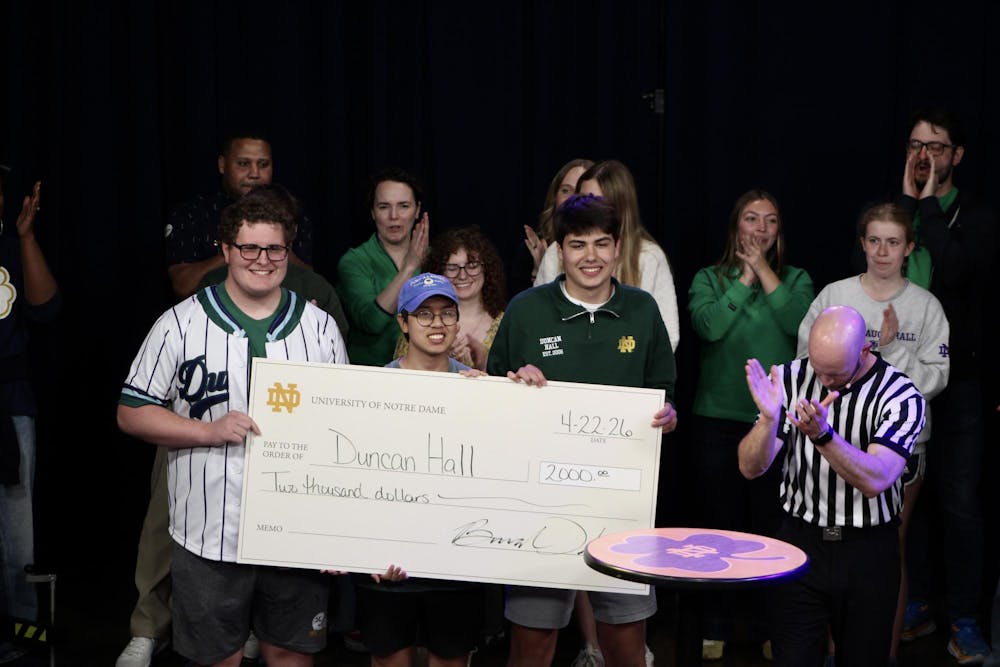
Sophomore Teddy Potts, the president of Duncan Hall, explained the dorm offered discounts at its in-hall restaurant for reaching certain milestones.
Coyle Rector’s ND Day tradition
Joey Quinones, rector of Coyle Hall, has completed a very long run as a motivator for people to donate for the last four years.
For his run this year, he elected to run 82 miles for the 82 new beds Coyle will gain when they move from their current temporary residence in Zahm Hall to their permanent residence in Coyle Hall.
Two years ago, he ran for 18 hours and 42 minutes, a reference to the University being founded in 1842. In this time, he completed 71 miles. Last year, he ran 73 miles for the 73rd, and final, year of Fisher Hall.
Different members of the Coyle community ran alongside him for most of the day.
“Running with others is kind of a cheat code to it,” Quinones said.
Editor’s Note: The Observer is a participant and beneficiary of Notre Dame Day fundraising. A previous version of this story had Michelle Cuneo's last name wrong.