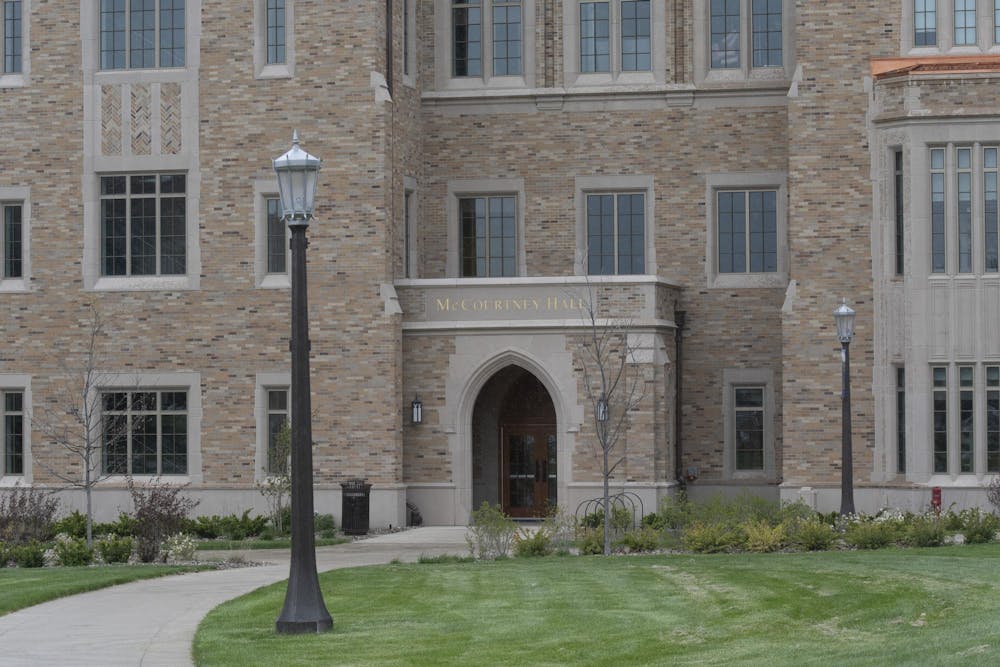
McCourtney Hall East has been awarded the Platinum level of a Leadership in Energy and Environmental Design certification by the U.S. Green Building Council. It is the 27th building at the University of Notre Dame to receive a LEED certification and the first to be classified at the council’s highest standard — Platinum.
The LEED rating system encourages development projects to aim for sustainable construction and building designs.
Projects register for LEED certification before breaking ground then pursue a series of credits that help the U.S. Green Building Council determine which level to award. The levels are Certified, Silver, Gold and Platinum.
The 200,000-square-foot research complex was completed in winter 2025 as an addition to McCourtney Hall, which received LEED Gold certification in 2016. The two projects headline a University plan to grow a campus quad composed of research buildings.
The University committed to pursuing LEED certifications for all of its construction projects in 2008. Geddes Hall became the first building on campus to receive a LEED certification when it achieved Gold in 2010. Since then, 16 buildings have received the LEED Gold distinction, and 10 others are certified at the LEED Silver level.
There are 110 credits available in the LEED rating system used to evaluate McCourtney Hall East. The next most recent building to be granted a certification was Graham Family Hall, a men’s residence hall, achieving Gold level with 64 credits in June 2025. McCourtney Hall East received 81 credits — one more than the minimum of 80 credits required for a Platinum certification.
A scorecard detailing which credits a construction project achieved is published in the LEED project directory. Graham Family Hall and McCourtney Hall East are publicly available, though at the discretion of project managers, scorecards can be made private.
The LEED scorecard is divided into nine sustainability metrics including water efficiency, indoor environmental quality and innovation.
The largest increase in credits for an individual category between McCourtney and Graham Family was in the Energy & Atmosphere section. McCourtney received 26 credits compared with the residence hall’s 15. The new research building fulfilled all three credits for renewable energy production and 13 of 18 credits for optimizing energy performance.
McCourtney received more credits than Graham Family in four sections, though it trailed the residence hall by a single credit in water efficiency.
The University did not respond to a request for comment.