
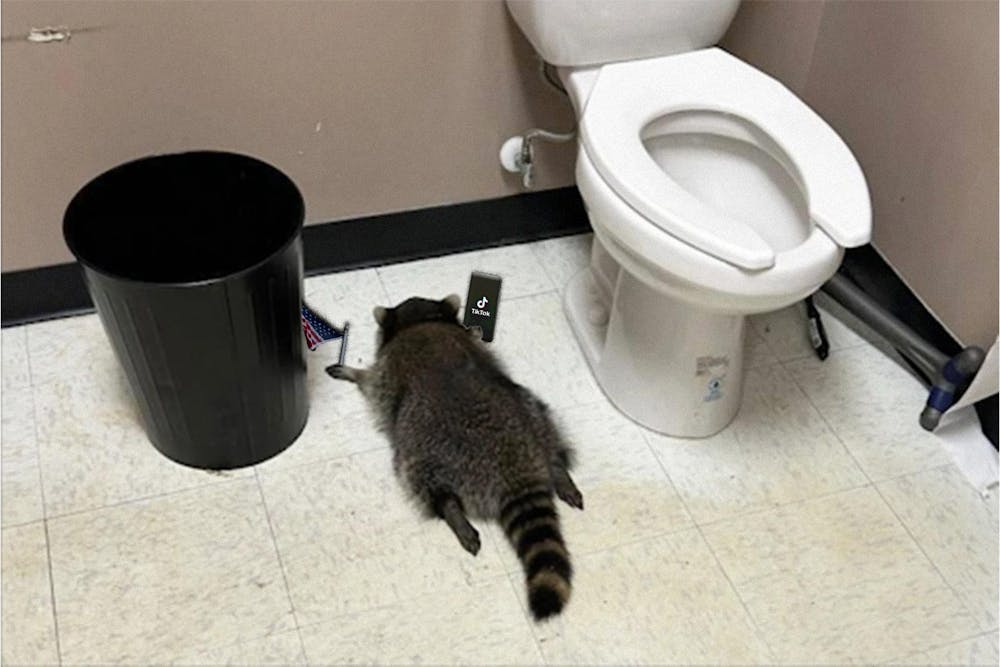
Last weekend, employees at a Virginia liquor store discovered destruction and desolation to an extent rarely seen. Bottles broken, spirits spilled, hooch in havoc. After extremely sophisticated forensic analysis, employees determined the culprit to be an extraordinarily intoxicated raccoon. Many people sent me articles from a variety of learned publications covering the raccoon’s rum rampage, showing photos from the unfortunate scene. From The Washington Post to rural regional TV channels, people couldn’t get enough of the plastered trash panda.
In fact, last week’s raccoon alcohol thievery wasn’t the first example of an intoxicated raccoon to capture the nation’s attention this year. Or the second. In September, a Kentucky nurse rescued a raccoon “reeking of booze.” In May, Ohio police discovered a raccoon in custody of a methamphetamine pipe. Clearly there’s no shortage of raccoons behaving poorly, no shortage of journalists eager to report their misdeeds and no shortage of people consuming their accounts.
While considering that the scale of America’s substance abuse crisis is so dire that even raccoons are affected, I turned my attention to Wednesday’s edition of The Observer. There I read Naasei Lynn’s piece, “Objectively subjective,” which references a Jonah Tran column which I personally wrestled with in September. Lynn agrees with Tran’s sentiment that The Observer’s opinion pages have been oversaturated with political commentaries on the Trump administration. Among The Observer’s columnists, there is an intriguing tension developing between people who want to write political columns and those who are frustrated with their ubiquity.
So where does the raccoon come in?
While the drunken raccoon achieved near-universal coverage, stories discussing several controversial scandals from the White House are largely reserved to the opinion pages of legacy newspapers and learned periodicals. For instance, the current administration is pursuing potentially illegal strikes on alleged Venezuelan drug boats, including intentionally killing defenseless survivors in the water. I’m not claiming that the media is not covering the controversy with the boat strikes, nor am I claiming that people aren’t talking about it. Yet, there remains a marked difference between the attention captured by the furry booze bandit and a potential war crime committed by the United States.
So why is that?
In 2023, the Pew Research Center conducted a poll that found 65% of Americans often feel exhausted when talking about politics, with 55% saying they feel angry. I would have to imagine that if the poll were conducted today, the results would be higher. Americans are fatigued with politics, and it’s clear that they are discontented with the current state of the rhetoric. When stories like the drunken raccoon come around, people are drawn to its hilarity and innocence (although the raccoon is obviously not innocent). It’s a form of escapism; focus turns away from real pressing issues to a funny but ultimately meaningless instance of a marauding mammal.
However, the liquor store raccoon can teach us a profound lesson about America. Unity is much closer than one may initially think; we are more alike than we realize. We can come together and enjoy a silly story about a mischievous raccoon. How hilarious is a rogue alcoholic trash panda?
We must recognize that we all love the raccoon. So why can’t we all love America too?
I don’t pretend to believe that America is anywhere near achieving consensus, but I deeply believe that most Americans are fundamentally in agreement that our republic is worth fighting for. While some want to criticize their political enemies’ “SEDITIOUS BEHAVIOR, punishable by DEATH” as the current president is wont to do, Americans should remember that their friend, family member, or neighbor of a different party is ultimately on the same team.
With this in mind, continuing political dialogue remains of paramount importance, even in a collegiate student newspaper. It’s easy to become jaded by the current state of political discourse, yet as patriotic Americans, we must continue to exercise our right (and obligation) to make our voices heard. Not only must our campus institutions remain devoted to protecting freedom of speech, we (as individuals) must make frequent use of that right.
On Sept. 17, 1787, founding father Benjamin Franklin was asked what form of government had been devised for the United States at the Constitutional Convention. His immortal reply was, “A republic, if you can keep it.”
We’ll only keep our republic if we keep talking about politics, rather than ignoring it because it’s uncomfortable. So yes, keep fighting in front of the mashed potatoes. Keep writing political columns in The Observer. We can talk about drunk raccoons all we want, but we better make sure to cover the important stuff too.
And we’re nowhere near a shortage.
Grayson Beckham is a freshman living in the Coyle Community in Zahm Hall. He hails from Independence, Ky. When he's not publishing woke propaganda inThe Observer, he studies political science and eloquently uses his silver tongue on the mock trial team. You can send him relevant hate mail at gbeckham@nd.edu.


